Indonesia U20's 3-0 Away Victory: Understanding Youth Team Cohesion and 'Newborn Calves' through the BaZi Lens of 'BiJie'
On September 4, 2026, the Indonesia U20 national team secured a stunning 3-0 away victory against host nation Laos in the Asian Cup qualifiers, showcasing remarkable team cohesion and resilience. This 'Garuda Muda' storm of youth perfectly embodies t
Opening Introduction
A resounding 3-0 away victory put the Indonesia U20 national team in the spotlight. Far from home against the host nation Laos, the youth squad showed no stage fright, instead bursting with astonishing fighting power. This psychological quality of treating an away game like home is, in traditional BaZi astrology, closely tied to the cohesive power of the BiJie (Peer) star and the pressure-handling capacity of the GuanXing (Authority) star.
This article does not involve any specific players' birth charts. Instead, from the philosophical angle of Chinese metaphysics, it explores how a young team, in the special temporal-spatial field of an 'away game,' activates the innate energy of 'newborn calves not afraid of tigers.' The ancients believed that personality traits and the grasp of timing are all hidden within the code of the Five Elements' interplay.
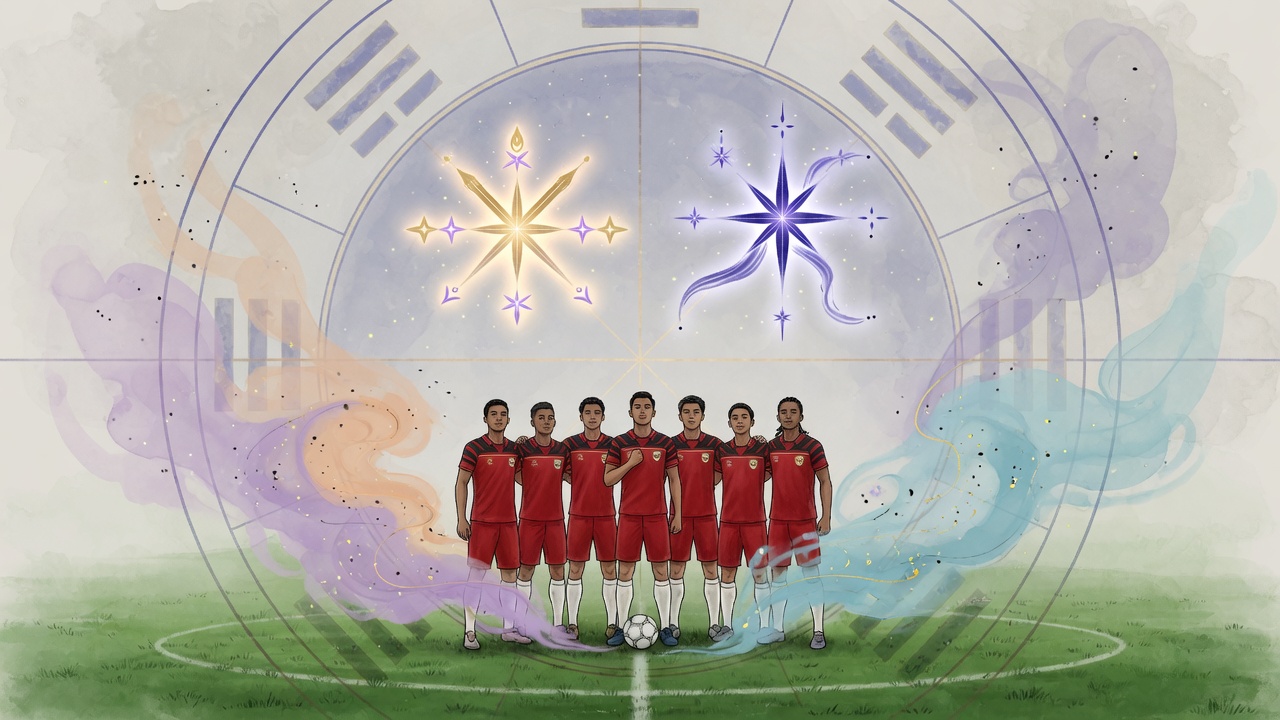
Basic Clarification: BaZi Is Not Fatalism, but an Energy Analysis Model
Common Misconceptions
- Misconception 1: BaZi can predict match outcomes. Chinese metaphysics is never used to predict specific event results; it only analyzes the energy tendencies and personality traits of individuals or groups in a given time and space, helping us understand the energetic logic behind behavior.
- Misconception 2: Strong BiJie guarantees a win. BiJie represents peers, teammates, and competition. It provides the potential for cohesion, but turning that into victory requires the rule-bound constraints of GuanXing and the strategic intelligence of ShiShang (Talent) — it is a comprehensive system.
- Misconception 3: Youth teams rely solely on youthful vigor. From a metaphysical standpoint, young people are indeed in the ascending phase of Wood-Fire flourishing, but behind 'newborn calves not afraid of tigers' lies the fearlessness brought by BiJie supporting the Self and the maturity of timing under GuanXing's checks and balances, not mere impulsiveness.
Core Insights: A Metaphysical Interpretation of BiJie, GuanXing, and Away Games
1. 'BiJie' as Brotherhood: The Metaphysical Foundation of Youth Team Cohesion
In the BaZi Ten Gods system, BiJian (Shoulder) and JieCai (Rob Wealth) are collectively called 'BiJie,' representing the same element and polarity as the Day Master. On a practical level, they symbolize peers, teammates, brothers, and collaborative partners. The high level of tacit understanding and mutual support displayed by Indonesia U20 in the away game is a classic manifestation of active BiJie energy.
When a group of young people find themselves on a foreign pitch, they naturally view their teammates as 'one of their own.' This psychological mechanism is known in Chinese metaphysics as BiJie supporting the Self. The more unfamiliar the away environment, the stronger the cohesive effect of the BiJie star, because individuals need to rely on their own kind to resist external pressure, forming an energy barrier of 'us versus them.'
- BiJian (Shoulder): Represents equal collaboration and stable support, akin to the unselfish, covering, and passing players on a team, providing lasting team resilience.
- JieCai (Rob Wealth): Represents strong competitive drive, adventurous spirit, and explosive power in the moment, like a striker's poaching shot—it brings the impulse and courage to break a deadlock.
- Key Mechanism: In an away game, the 'alienation' of the external environment triggers the BiJie star's herding response in the chart. Individual self-awareness diminishes, and the collective 'we' of the team is magnified, creating a synergistic effect where 1+1>2.
2. 'GuanXing' as Pressure: The Metaphysical Code of Away-Game Resilience and Rule Adaptation
ZhengGuan (Direct Officer) and QiSha (Seven Killings) are collectively called 'GuanXing,' representing rules, discipline, pressure, challenges, and authority. In a football match, GuanXing can correspond to the referee's decisions, the opponent's attacks, the away crowd's jeers, and the constraints of the entire tournament system. Indonesia U20's ability to remain calm and execute tactics efficiently in the Laos home ground indicates that the GuanXing energy in their collective chart was positively transformed.
The ancients said, 'Without Guan, one feels light.' But Chinese metaphysics places more emphasis on 'a strong Self can take on Guan.' If a young team has sufficient BiJie energy, it can transform the pressure of GuanXing into forward momentum, just as turning away boos into cheers. Conversely, if BiJie is weak, GuanXing becomes an unbearable burden, leading to distorted movements and a fragile mentality.
- ZhengGuan (Direct Officer): Represents orderly defensive organization and strict adherence to tactical discipline. It allows the youth team to avoid losing control due to emotional fluctuations in an away game, maintaining formation stability.
- QiSha (Seven Killings): Represents the direct threat and sudden crises posed by the opponent. It stimulates the team's stress response and fighting will. If properly controlled and transformed, it can instead create a story of 'rising to the occasion against a strong opponent.'
- GuanXing Flow: When the energies of BiJie and GuanXing are balanced, the team can maintain internal unity while effectively coping with the challenges of rules and opponents, realizing a virtuous cycle of 'control within generation.'
3. 'Newborn Calves Not Afraid of Tigers': The Timing Perspective and Wood-Fire Momentum of Youth Charts
Traditional Chinese metaphysics correlates life stages with the Five Elements: youth corresponds to the Wood element, which is the Lesser Yang Qi, governing growth, upward movement, and fearlessness. Wood's nature inherently possesses the courage to break through the earth, caring little for consequences. This highly aligns with the psychological state of 'newborn calves not afraid of tigers.' Most Indonesia U20 players are at the peak of this stage, their Wood Qi vigorous and not yet fully subdued by Metal.
From a deeper metaphysical philosophy, 'not afraid of tigers' is not blind arrogance but an instinctive grasp of timing. The ancients believed that when a chart features a powerful BiJie formation and a controlled GuanXing, young people will naturally sense the opportunity that 'this moment is doable.' The away victory over Laos was perhaps just such a spontaneous action under this resonance between heaven and human.
- Wood Governs Benevolence: The drive of a youth team carries a pure love for football. This 'benevolent' energy makes them disregard personal gains and losses on the field, dedicating themselves entirely to the team.
- Fire Governs Propriety: Wood generates Fire. Fire represents passion, speed, and creativity. The flashes of brilliance displayed by the youth team in fast-paced confrontations are the outward manifestation of Wood-Fire flourishing talent.
- Timing Mastery: Chinese metaphysics emphasizes 'waiting for the right moment to act.' Youth itself is the best 'moment,' because at this stage, BiJie is strongest and GuanXing is weakest, making it the golden window to break authority and create miracles.
Avoidance Guide: Rationally Viewing the Connection Between Chinese Metaphysics and Sports
Important Notes
- Reminder 1: Do not apply this personally. All analysis in this article is based on traditional cultural philosophy and does not target any specific player, coach, or match result. Every individual's chart is unique. You cannot simply apply the formula 'youth = strong BiJie.'
- Reminder 2: Excessively strong BiJie has hidden dangers. Chinese metaphysics emphasizes balance. If a team's BiJie energy is too strong and lacks GuanXing constraint, it may devolve into a 'loose sand' of individuals fighting alone, lacking tactical discipline. Indonesia U20's victory precisely shows they found the balance between cohesion and discipline.
- Reminder 3: The away advantage is a double-edged sword. An away environment stimulates BiJie unity, but if internal JieCai stealing Guan (individual heroism challenging tactical authority) occurs, it can accelerate collapse. A young team needs a 'GuanXing-type' leader who can channel BiJie energy onto the right path.
- Reminder 4: Even if Wood Qi is strong, it needs Metal to prune. The drive of a youth team needs experience (Metal) to be refined. In Chinese metaphysics, Metal controlling Wood is a necessary pruning and shaping. The growth of young players is inseparable from veteran guidance and post-match review; one cannot blindly pursue 'not fearing tigers' while neglecting learning.
- Reminder 5: Avoid fatalistic interpretations. The outcome of a match is determined by countless real-world factors: training level, tactical arrangements, on-field performance, and even luck. Metaphysical analysis only provides a cultural perspective on personality and energy interpretation; it is by no means a predictive tool.
Summary and Recap
Indonesia U20's 3-0 away victory over Laos is a classic example of the perfect interplay between a youth team's BiJie cohesion and GuanXing pressure resistance. From a BaZi perspective, the courage of 'newborn calves not afraid of tigers' stems from the innate energy of the Wood-Fire youth phase, the team mechanism of BiJie supporting the Self, and an instinctive grasp of timing.
Traditional culture reminds us that true strength comes from the dynamic balance between internal unity (BiJie) and adaptation to external rules (GuanXing). This victory is not only a sporting triumph but also a vivid footnote to the resonance of 'human harmony' and 'heavenly timing' in the philosophy of Chinese metaphysics. View BaZi rationally—it is merely a cultural mirror that helps us understand ourselves and our teams better.