From Ryutaro Imai’s Kamen Rider Look: How “Shangshi Xiexiu” in BaZi Creates Iconic Faces
Recently, Japanese tokusatsu drama Kamen Rider Zetts leading actor Ryutaro Imai gained popularity for his role “Manzumo,” with his chiseled facial lines matching the armored design in the show, drawing attention. From a traditional BaZi perspec
Opening Introduction
Recently, Japanese tokusatsu drama *Kamen Rider Zetts* leading actor Ryutaro Imai gained popularity for his role “Manzumo,” with his chiseled facial lines matching the armored design in the show, drawing attention.
From a traditional BaZi perspective, the resonance between an actor and a character’s aura can often be attributed to the synergy of two energy modes: Shangshi Xiexiu (Talent Expression) and Yinxing Huaxiang (Resource Transformation).
This article is a rational cultural and character analysis educational piece, involving no personal birth data, privacy, or real-world predictions.
Basic Clarifications
Common Misconceptions
- Misconception #1: Attributing an actor’s success simply to “good destiny.” BaZi focuses more on energy configurations and personal traits rather than a simplistic good or bad.
- Misconception #2: Considering “Shangshi” as an inauspicious star. In BaZi, Shangshi represents talent, expression, and creativity, and it is neutral in nature.
- Misconception #3: Equating “Yinxing” with academic degrees or certificates. The core meaning of Yinxing is inner cultivation, image sedimentation, and aura formation.
- Misconception #4: Believing that facial features can be judged independently from BaZi. Traditional physiognomy emphasizes that facial features should be combined with BaZi and overall aura.
- Misconception #5: Forcing one trait onto all actors. BaZi emphasizes configurations; a single Ten Gods cannot define a person's development.
- Misconception #6: Misinterpreting traditional cultural education as real-world prediction. This article discusses only performing symbols and aura logic, not auspicious or inauspicious outcomes.
Fundamental Concepts
- Day Master: The Heavenly Stem of the birth day, representing the person's core energy and key traits.
- Shangshi (Talent): What the Day Master produces, symbolizing talent, expression, creativity, and outward display, divided into Shishen (Eating God) and Shangguan (Hurting Officer).
- Yinxing (Resource): What produces the Day Master, symbolizing absorption, cultivation, learning, image building, and aura sedimentation, divided into Zhengyin (Direct Resource) and Pianyin (Indirect Resource).
- Xeixiu: The Shangshi energy precisely showcases the essence of the Day Master, like a carved jade radiating brilliance.
- Haxiang: Inner energy transforming into an external image symbol, similar to the actor becoming the “vessel” of the character.
- Configuration Coordination: Shangshi and Yinxing are not opposites; they often need mutual restraint to create a stable aura.
Core Points
Shangshi Xiexiu: How an Actor’s Expressive Drive Externalizes into Character Charisma
In BaZi, Shishen (Eating God) and Shangguan (Hurting Officer) are collectively called “Shangshi,” representing a person’s expression, creativity, and desire to display.
When Shangshi energy is strongly supported by the Day Master, it is called Shangshi Xiexiu, meaning talent can be naturally showcased without being exaggerated.
- Energetic Foundation: Only a strong Day Master can harness Shangshi; otherwise conflicts like “Shangguan challenges the Officer” may arise. Actors need inner confidence to support intense performances.
- Expressive Tension: People with strong Shangshi have rich facial expressions and expressive eyes, easily conveying complex emotions on camera, suitable for the exaggerated style of tokusatsu.
- Role Fit: The character “Manzumo” played by Ryutaro Imai requires coldness and power. Controlled Shangshi manifests as restrained explosiveness, not rage.
- Creativity Mapping: Shangshi also governs innovation; actors often give characters unique mannerisms or aura, forming personal identifiers that audiences remember.
- Facial Language: When Shangshi energy is outwardly expressed, facial dynamics become more infectious. Ryutaro Imai’s hard facial contours and tight jawline enhance the heroic quality.
- Beauty of Xiexiu: Shangshi is like an outlet for inner energy, allowing actors to naturally reveal emotions on camera without stiffness, making it easy for audiences to empathize.
- Balance in Measure: Excessive Shangshi without control can appear exaggerated or emotional; with Yinxing or BiJie (Peers) restraint, it turns into mature, controlled acting.
- From “Ating” to “Living”: Actors who succeed in Shangshi Xiexiu often make the audience feel the character is an extension of their own aura, not just an act.
- Tokusatsu Adaptation: The Kamen Rider series requires highly symbolic performance; Shangshi energy can concretize abstract heroic qualities into body language and facial expressions.
- Expulsion and Restraint: Excellent heroic roles need both instant explosive power and long-term forbearance; the combination of Shangshi and Yinxing provides this tension.
- Audience Appeal: People with moderate Shangshi usually have likability or attractiveness, which is an important foundation for an actor’s breakout, but not the sole factor.
- Industry Regularity: Many famous actors have powerful Shangshi in their charts, but success also requires the cooperation of luck cycles (Da Yun) and work quality; the natal chart alone cannot decide.
Yinxing Huaxiang: How Aura Sedimentation Forms an Iconic Symbol
Zhengyin (Direct Resource) and Pianyin (Indirect Resource) are collectively called Yinxing, representing inner cultivation, learning ability, and image construction.
Yinxing can transform the sharpness of Shangshi into a calm charisma, forming an unforgettable “mask-like” impression, known as Huaxiang.
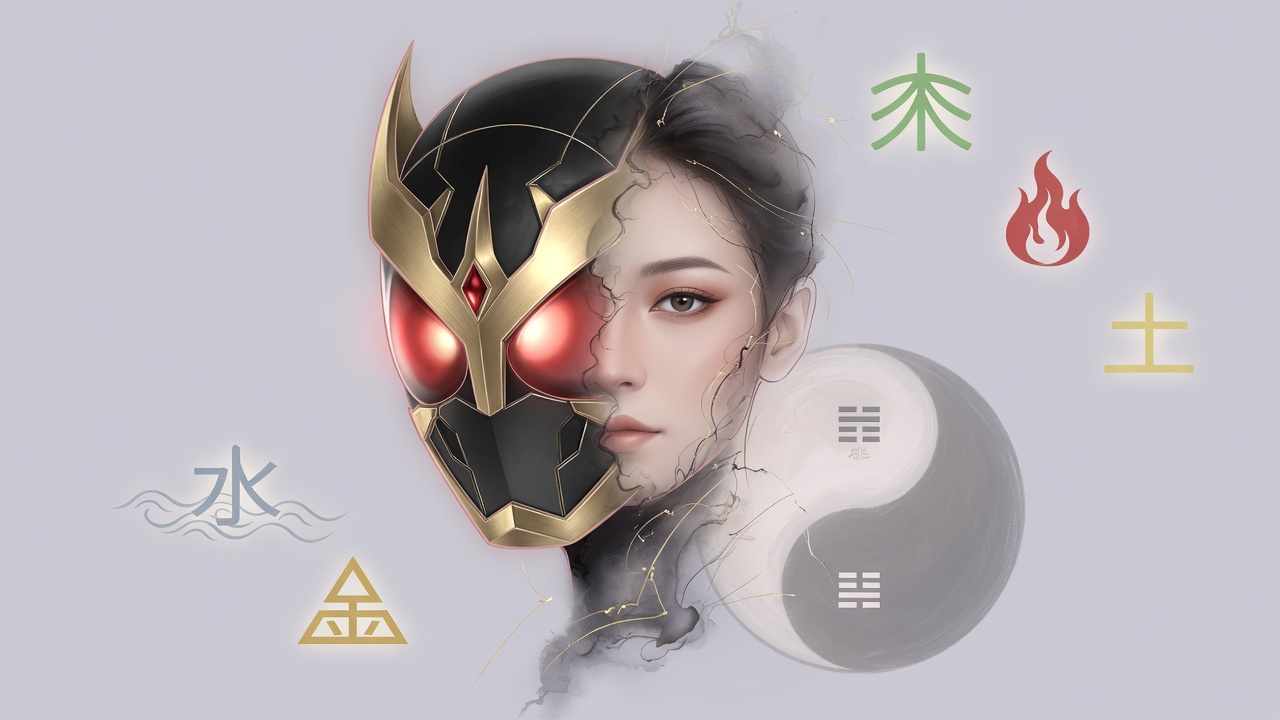
- Definition of Huaxiang: Huaxiang means transforming inner energy into external image symbols, like the fusion of a character mask with the actor’s true face, forming a unified visual language.
- Distinctive Contours: When Yinxing is controlled, facial contours tend to be clear and sculptural, suitable for being made into figurines or iconic looks. Ryutaro Imai is an example.
- Aura Inwardness: People with strong Yinxing often carry a sense of aloofness or mystery, naturally fitting the “solitary hero” setting of Kamen Rider, enhancing character credibility.
- Energy Modulation: Shangshi governs “release,” Yinxing governs “retention.” When they work in harmony, the actor can both express freely and maintain character depth, avoiding superficiality.
- Symbolization Potential: When Yinxing Huaxiang is successful, the actor’s face easily becomes a memory anchor for the audience, even becoming part of the IP’s visual elements, favouring merchandise sales.
- Sedimentation and Longevity: Yinxing represents accumulation, which helps actors maintain character consistency across a long-running series, avoiding inconsistent personas or contradictions.
- Not Just Facial Features: BaZi pays more attention to overall aura and the “image” on screen, rather than mere proportions of facial features. Recognizability matters more than standard beauty.
- Ryutaro Imai Case: His hard facial lines form a unified visual language with the armor and harness design in the show, an intuitive demonstration of Huaxiang.
- Mask and Real Face: In the Kamen Rider series, half of the actor’s face is covered, which instead highlights the eyes and lower facial contours; Yinxing Huaxiang is especially crucial here.
- From Role to Symbol: When the actor’s face itself becomes a character symbol, the audience can recognize them even without the suit—this is the long-term effect of Huaxiang.
- Inner Cultivation: Yinxing also represents learning and contemplation. Actors good at character analysis can infuse deeper psychology into roles, not surface imitation.
- Avoid Mythologizing: Yinxing Huaxiang is merely one interpretation in the BaZi model; in reality, makeup, lighting, camera work, and industry collaboration are needed to realize it.
The “Qi–Xiang” Resonance Between Face and Character: The Full Chain from Shangshi to Yinxing
An actor’s breakout is often the result of the synergistic effect of Shangshi Xiexiu and Yinxing Huaxiang.
The former provides expressive tension, the latter gives the character soul and symbolic value; both are indispensable.
- First comes “Qi”: Shangshi provides the inner drive to express, determining whether the actor can handle a high-energy role. Without Shangshi’s agility, acting can be stiff.
- Then comes “Xiang”: Yinxing consolidates the impulse into memorable visual and aura identifiers, such as the gaze behind a cold mask, the tight lip line.
- Role’s Reverse Shaping: Long-term portrayal of a certain character type reinforces personal aura, forming a BaZi feedback loop where the actor gradually converges with the role.
- Birth of an Iconic Symbol: When audiences instantly associate the actor’s face with the character, it signals completion of Huaxiang. Ryutaro Imai is at this stage.
- Tokusatsu’s Amplification: The Kamen Rider series emphasizes symbolic appearances; mask and suit design naturally magnify the actor’s facial features and body language.
- Avoid Over-Interpreting: Not all breakout actors must have the Shangshi-Yinxing combination; configurations vary widely. BaZi analysis must be based on specific charts.
- Rational View of “Fit”: BaZi is an analytical tool, not a substitute for acting skill, scripts, production, etc. Breakout is a multi-cause outcome.
- Cultural Education Boundary: This article discusses only aura logic, not personal BaZi calculation or privacy. All analysis is based on public image and cultural models.
- Dynamics of Shangshi and Yinxing: Strong Shangshi with weak Yinxing may result in brilliant but unsustainable sharpness; excessive Yinxing with weak Shangshi may create a aloof aura but lack expressiveness.
- Ideal Ratio: When Shangshi and Yinxing energies are balanced, and the Day Master is strong, it is easiest to form an actor aura that is both impactful and enduringly watchable.
- Physognomy and BaZi: Traditional BaZi holds that facial features map inner aura, but in modern entertainment, styling can enhance or modify certain traits.
- Symbol Durrability: Once Huaxiang is successful, the actor may be bound to the character—both an opportunity and a challenge, requiring follow-up works to break through.
Avoidance Guide
Analysis Avoidances
- Reminder 1: Do not speculate on an actor’s real birth data. Without an accurate BaZi chart, all analysis is cultural discussion based on public aura, not conclusive.
- Reminder 2: Do not equate “strong Shangshi” with “must be suited to acting.” Acting success also requires luck cycles, effort, and industry opportunities.
- Reminder 3: Yinxing Huaxiang is not about “looking good.” Aura is unrelated to facial beauty; it emphasizes recognizability and symbolic quality. Both hard and soft features can achieve Huaxiang.
- Reminder 4: Avoid using a single Ten Gods to determine auspice. For example, overly strong Shangshi without control may bring emotional fluctuations or reputational controversy; holistic analysis is needed.
- Reminder5: Tokusatsu styling enhancements should not be attributed to BaZi. Mask and armor designs are the work of art teams; the actor is only one carrier.
- Reminder6: Do not conflate a character’s fate with the actor’s fate. Actors merely perform; BaZi analysis is not tied to the character, nor does it predict the actor’s real life.
- Reminder7: Public image is the result of team packaging, not necessarily the original BaZi. Makeup, lighting, and post-production all affect “aura” presentation.
Rational Attitude
- Attitude1: Cultural education should maintian humility. BaZi is a traditional thinking model, not a scientific law, and cannot replace realistic judgment.
- Attitude2: If interested in BaZi, systematically study fundamental theories, avoiding fragmented application or online fortune-telling.
- Attitude3: Respect actors’ privacy; do not make malicious speculations or personal attacks. Discussion is limited to public image and character portrayal.
- Attitude4: Acting success is a multi-factor outcome; BaZi analysis merely provides one observation angle, its role should not be exaggerated.
- Attitude5: When appreciating actors, focus on their acting, works, and professional attitude, rather than overly fixating on private charts.
- Attitude6: The BaZi concepts here are only used to explain the “aura compatibility” phenomenon; they do not constitute any practical advice or predictions.
Sumary and Review
Ryutaro Imai’s rise to fame is closely linked to the fit between his facial aura and the character’s styling. From a BaZi perspective, this perfectly illustrates Shangshi Xiexiu providing expressive tension and Yinxing Huaxiang solidifying iconic symbols.
Yet BaZi is merely a cultural analytical tool; acting success cannot be separated from work quality and personal effort. Rational viewing brings genuine enjoyment.