BaZi on Han Ji-yoon: A Traditional Cultural Logic of Character, Choice, and Timing Through a Baseball Comeback
On July 26, 2026, Hanwha Eagles’ Han Ji-yoon turned the game around in the bottom of the 8th, sparking a 10-run explosion and becoming a hot topic in South Korea. This “impossible” victory mirrors the eruption of the Day Master in BaZi when a **L
Opening Introduction
When Hanwha was tied in the bottom of the 8th, Han Ji-yoon stepped in and instantly rewrote the script. This kind of “counter-momentum eruption” is often seen as luck, but in BaZi destiny analysis, it is frequently the precise alignment of innate endowment and acquired timing.
Without discussing any personal birth data, this article uses the moment as a springboard to rationally explain how BaZi constructs a systematic life reference through the three dimensions of character genetics, nodes of decision, and windows of opportunity.
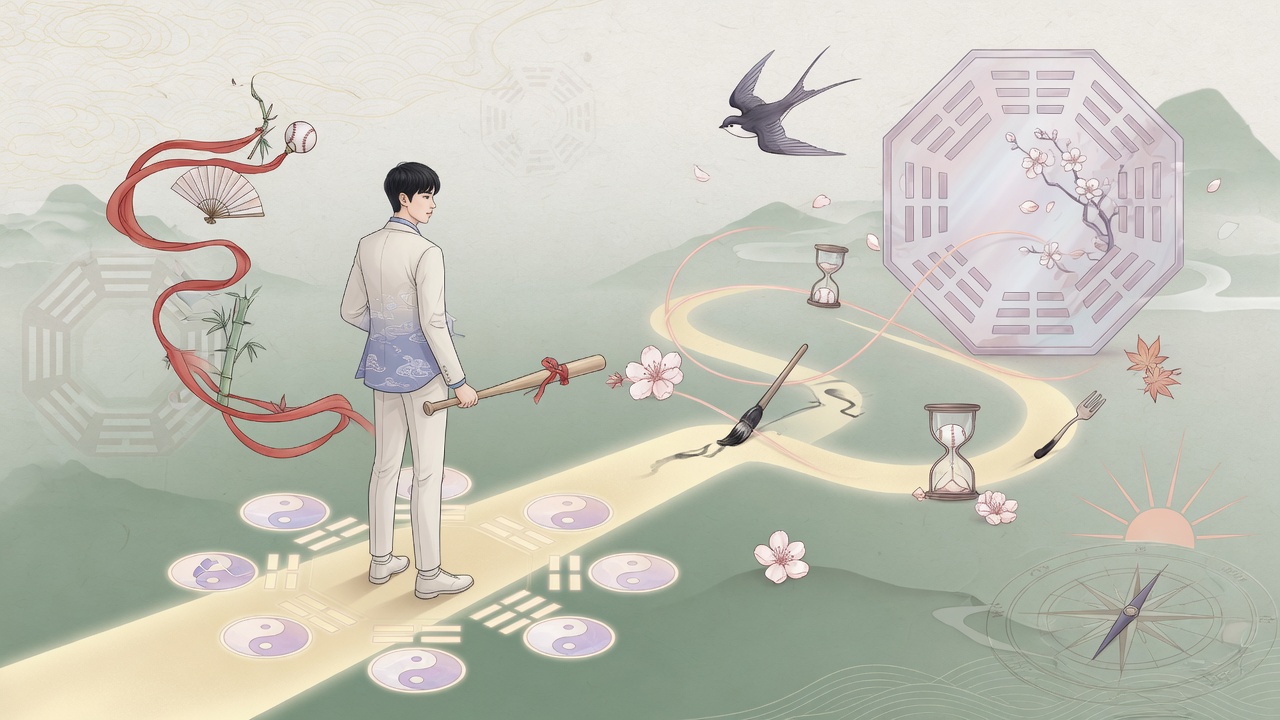
Basic Clarification: BaZi Is Not Fatalistic Prophecy
Common Misconceptions
Many people hold deeply ingrained misunderstandings about BaZi, viewing it as an ironclad “fortune-telling art.” This deviates from its essence as a life algorithm and a tool for self-cognition.
- Misconception 1: BaZi decides your fate. In reality, BaZi describes your innate energy configuration and potential trends, much like giving initial parameters and a weather forecast—but the path walked and whether you use an umbrella entirely depend on personal choice.
- Misconception 2: Good fate vs bad fate binary. BaZi has no absolute good or bad; the key lies in Five Element circulation and structural synergy. A so-called “poor” configuration can, under specific timing, ignite remarkable resilience.
- Misconception 3: Luck Pillars and Annual Cycles are single-event triggers. Timing is more like climate change—it alters the ambient energy field, influences judgment and emotion, rather than mechanically pressing a button for a specific event.
Core Points: The Trio of Character, Choice, and Timing
III. Windows of Timing: The “Energy Climate” of Luck Cycles
Understanding timing is not about passively waiting for “good luck,” but about deeply cultivating during energy troughs and boldly acting during energy peaks. From a metaphysical lens, Han Ji-yoon’s explosion is a perfect bloom of personal skill within a window of timing—a convergence of long preparation and the right “energy climate.”
- Energy Resonance: When an Annual Cycle’s Five Element aligns with the chart’s favorable deity, one feels “smooth momentum,” with heightened judgment, execution, and opportunity perception. It’s like sailing with the wind—double the result with half the effort.
- Structure Activation: Certain special structures (e.g., Following Structure, Transformation Structure) are only “triggered” during specific Luck Pillars or Annual Cycles. Once activated, personal energy releases exponentially, demonstrating capabilities far beyond the usual.
- Clash and Combination Together: When an Annual Cycle violently clashes a key point in the natal chart (e.g., Zi-Wu clash), it often signifies drastic changes and sudden events. Yet for a strong chart, a clash can also mean “breaking open,” smashing a stalemate and breaking through. The turnaround after being tied in the bottom of the 8th can be seen in metaphysics as a manifestation of “favorable clash.”
- Tomb/Warehouse Opening and Closing: The branches Chen, Xu, Chou, Wei are the Four Tombs/Warehouses, representing storage and suppression. If an Annual Cycle opens the tomb, pent-up energy is released instantly, like a floodgate bursting—explosive power. Such years often witness stunning reversals or overnight fame.
Pitfall Guide: Rationally Viewing BaZi and Life
Points to Note
- Never force-fit or blindly apply. Without accurate birth data, all analysis remains cultural education. Even with data, BaZi requires holistic dialectical analysis; inspecting only one pillar or one deity easily leads to misreading.
- Avoid the “auspicious vs inauspicious” binary. A turnaround is thrilling on the field, but in life it may correspond to drastic upheaval. In BaZi, a “clash” signifies breakthrough but can also bring instability. The point is how to leverage the trend to cultivate the mind, not simply label things good or bad.
- Luck Pillars and Annual Cycles are not universal remote controls. Timing affects the energy field and psychological tendencies, not directly manipulating events. The final choice always rests with the individual. Under the same pressure, some collapse, some erupt—the difference lies in chart foundation and acquired cultivation.
- Beware of “fortune-telling dependency.” BaZi is a tool for self-knowledge, not a crutch to replace thinking. Obsessing over daily omens weakens autonomous decision-making and resilience under pressure.
- Note cultural differences. BaZi originates from Chinese tradition; while widely spread in Korea, interpretation must integrate modern context. Avoid excessive interpretation or privacy voyeurism toward public figures using metaphysical concepts.
- Distinguish fact from metaphor. This article uses the game as a lead, treating BaZi logic as an analytical framework and cultural metaphor—absolutely not any assertion about Han Ji-yoon’s personal fate. All descriptions remain within the scope of traditional cultural discussion.
Recap and Summary
Han Ji-yoon’s comeback moment is a perfect metaphor for the triple resonance of innate character, split-second choice, and the energy of timing. BaZi culture offers precisely a rational grammar for understanding such resonance: it does not predict specific events but reveals the deep logic between energy configurations, decision tendencies, and the ebbs and flows of timing. True wisdom lies in using this grammar to read yourself, so that when your own “bottom of the 8th” arrives, you have the power to swing that decisive blow.