From Korea's Gaecheonjeol to the Heavenly Stems and Earthly Branches: How Festival Calendars Reflect National Origin Myths
On October 3, 2026, South Korea celebrates Gaecheonjeol (Opening of Heaven Day). This day, commemorating Dangun's founding of Gojoseon, is deeply interwoven with the East Asian sexagenary cycle (Ganzhi) system. Ancient histories anchored the
Opening Introduction
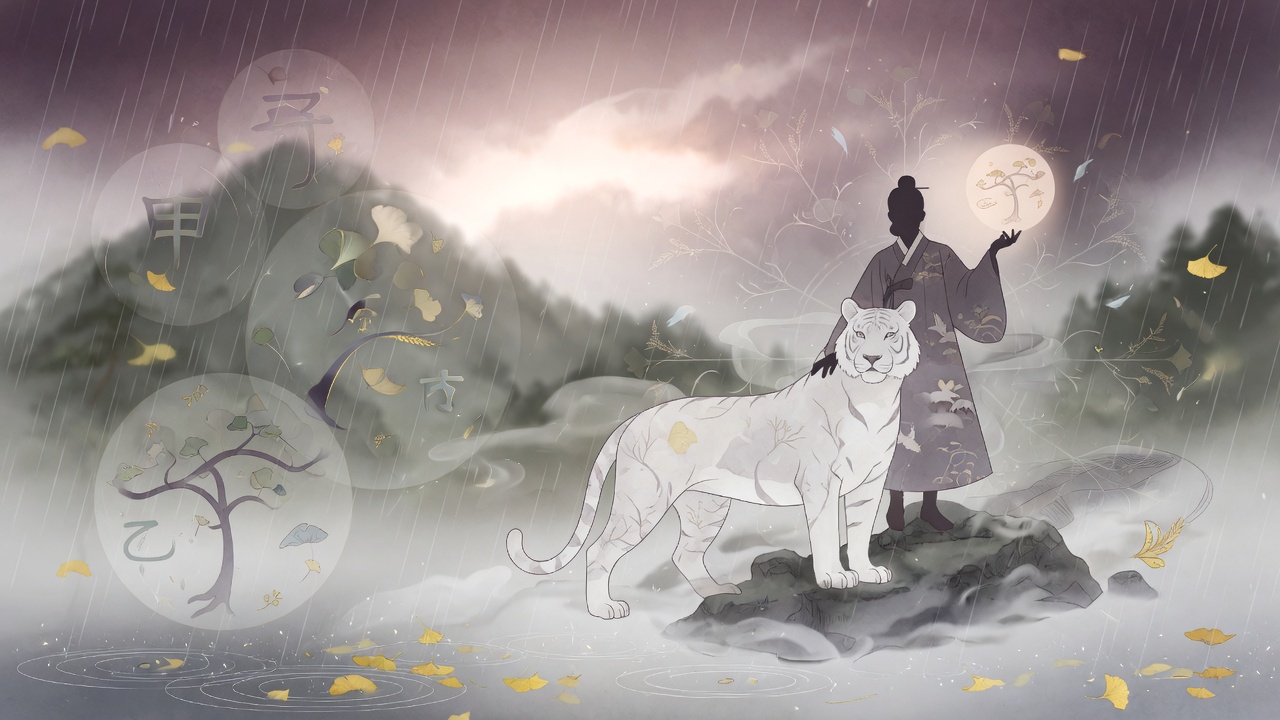
On October 3, 2026, South Korea observes Gaecheonjeol, honoring the peninsula's progenitor Dangun who established Gojoseon. This year the holiday falls just two days before Cold Dew, with rain across the nation. This day centered on national origins is in fact deeply interwoven with the East Asian sexagenary cycle system — the record of '2333 BCE' in the Dangun founding myth is a clever projection of the Ganzhi calendar. This article rationally interprets how the Heavenly Stems and Earthly Branches became symbolic carriers of festival culture and national memory.
Basic Clarifications
Common Misconceptions
The Heavenly Stems and Earthly Branches are often seen as fortune-telling tools, but their essence is a precise calendrical notation for recording time grids. The Ganzhi system behind Gaecheonjeol also carries a historical narrative function, not superstitious fortune-telling.
- Misconception 1: Bazi equals fortune-telling. Bazi is originally a Ganzhi symbolic record of one's birth time grid — a precise calendrical scale. Fortune-telling is only one of its later derivative applications.
- Misconception 2: The Ganzhi system belongs exclusively to China. Although originating in ancient China, the Ganzhi system was transmitted to the Korean peninsula early on and fused with local myths, forming a unique cultural expression.
- Misconception 3: The Ganzhi combination for Gaecheonjeol is fixed. The Ganzhi combination for Gaecheonjeol changes each year according to the Gregorian–lunar calendar correspondence. In 2026 it is Bingwu year, Dingyou month, Gengxu day; the following year will bear another set of symbols, reflecting the flow of time.
The Ganzhi Calendar and the Time-Grid Code Behind Gaecheonjeol
Heavenly Stems and Earthly Branches: An Endlessly Cyclical Time Ruler
The Heavenly Stems and Earthly Branches consist of ten Stems and twelve Branches paired together. Their least common multiple is 60, forming the sexagenary cycle. This system records not only years but also months, days, and hours, constituting a rigorous set of time coordinates.
- Ten Heavenly Stems: Jia, Yi, Bing, Ding, Wu, Ji, Geng, Xin, Ren, Gui — each associated with the Five Phases (Wood, Fire, Earth, Metal, Water) and divided into yin and yang.
- Twelve Earthly Branches: Zi, Chou, Yin, Mao, Chen, Si, Wu, Wei, Shen, You, Xu, Hai — corresponding to zodiac animals, hours, and monthly markers, they are symbols that delineate natural rhythms.
- The sexagenary cycle can continuously record years, months, days, and hours, forming a unified calendrical language across ancient East Asia. The date of Gaecheonjeol is repeatedly anchored within this cycle.
- Gaecheonjeol is fixed on October 3 in the Gregorian calendar, often falling around the end of the eighth lunar month or early ninth, near the Cold Dew solar term. The cool, clear post-harvest atmosphere resonates with the Metal qi of the Ganzhi system.
The Rooting and Evolution of the Ganzhi Calendar on the Korean Peninsula
Around the turn of the Common Era, Chinese characters and the calendar system were transmitted to the Korean peninsula, and the Ganzhi calendar became the standard framework for historical records during the Three Kingdoms period. Records in the *Samguk Sagi* and *Samguk Yusa* clearly show this system taking root.
- The Gwanggaeto Stele of Goguryeo already uses the Ganzhi calendar, indicating that by the early fifth century Korea was proficiently employing this time-recording method.
- The *Samguk Sagi* records the accession of Hyeokgeose, the founder of Silla, as 'the first year of Wufeng of Han Emperor Xuan, a Jiazi year.' The Jiazi year became a computational tool for constructing founding myths.
- During the Joseon dynasty, official almanacs fully followed the Shixian calendar, using Ganzhi to mark solar terms, rituals, and holidays, deeply embedding national commemorations like Gaecheonjeol into the calendrical tradition.
- A single calendrical system could travel across borders and endure for nearly two millennia precisely because it uses minimalist symbols to present the fusion of natural cycles and human time.
The Gengyin Code in the Dangun Founding Legend
According to the *Samguk Yusa*, Hwanung descended to Mount Taebaek, and later Dangun Wanggeom established the capital at Pyongyang in 'the 50th year of Emperor Yao's reign, a Gengyin year.' This Gengyin year became the key to unlocking the time of national origin.
- The original text states: 'At that time a bear and a tiger lived together in a cave... transformed into a woman... gave birth to a son named Dangun Wanggeom, who, in the 50th year of Emperor Yao's accession, a Gengyin year, established the capital at Pyongyang and first called the country Joseon.' It explicitly gives a Ganzhi year.
- Later scholars, using the era of Emperor Yao in Chinese histories, retroactively calculated Gengyin as 2333 BCE, thus establishing the Dangun era, which became part of today's 'Dangun calendar'.
- This practice is not accidental but a common method in the East Asian cultural sphere of anchoring national origins to a credible calendar. The Jinmu era in Japan and the legend of the Hung Kings in Vietnam also contain sexagenary marks.
- From a mythological perspective, fixing the founding moment within the endlessly cyclical Ganzhi system endows the narrative with a legitimacy within cosmic order, allowing legend and calendar to mutually authenticate each other.
The Ganzhi Moment of Gaecheonjeol 2026: Bingwu Year · Dingyou Month · Gengxu Day
This year's Gaecheonjeol falls on October 3, 2026, the 23rd day of the eighth lunar month in a Bingwu year. In the day's Four Pillars, the day pillar is Gengxu, and the month order still belongs to You month, presenting the deepening autumn atmosphere as Metal qi grows stronger.
- Year pillar Bingwu: Bing Fire and Wu Fire — both stem and branch are Fire, forming a 'Yang Blade structure,' symbolizing fervor and transformation.
- Month pillar Dingyou: Ding Fire sitting on You Metal, mid-autumn of the eighth month, before Cold Dew. The You month represents mature harvest and a sense of order, perfectly matching the festival's mood of gratitude to heaven and ancestors.
- Day pillar Gengxu: Geng is Yang Metal, Xu is the Fire repository, containing hidden Xin Metal and Ding Fire. Earth generates Metal, Metal generates Water, forming an imagistic dialogue of 'Metal generating Water' with the autumn rain during the holiday.
- These symbols are not fate predictions but Five-Phase markers on a slice of time, like an abstract solar-term painting that allows one to intuitively feel the rhythm of cosmic cycles.
Cultural Decoding of the Festival's Five-Phase Imagery
The cultural imagery formed by Ganzhi symbols and Five-Phase theory in Gaecheonjeol can help us understand how traditional culture integrates natural laws with humanistic emotions.
- The harvest meaning of Metal Autumn: The Heavenly Stems Geng and Xin, and the Earthly Branches Shen and You all belong to Metal, corresponding to autumn. By Gaecheonjeol the rice has been harvested — exactly the season for feeling gratitude for heaven's grace and earth's bounty.
- The creative metaphor of Earth generating Metal: In the Dangun myth, the bear transforms into a woman and gives birth to the progenitor. The bear image belongs to Earth; from Earth emerges civilization (Metal), forming a resonance with the Bazi Five-Phase principle of Earth generating Metal.
- The balance of Water and Fire already achieved: The year stem-branch Bingwu belongs to Fire, while the autumn You month belongs to Metal, implying the forging imagery of Fire refining Metal into a vessel — fitting the 'Opening of Heaven' as the creation of civilization.
- These correspondences have no scientific basis, yet they are a cultural creation of analogical thinking, turning the holiday into more than a day off — it becomes a ritual dialogue with the rhythms of heaven and earth.
A Rational Stance on Destiny Symbolism: No Divination, Only Interpreting Time
Examining Gaecheonjeol through a Bazi lens is by no means an encouragement to predict national fortune or individual luck; rather, it reveals the profound cultural significance of the Ganzhi symbols. The original function of destiny study is to describe temporal attributes, not to judge fate.
- Bazi destiny study originally came from the 'Five Movements and Six Qi' theory, a tool for modeling spatiotemporal characteristics using Heavenly Stems and Earthly Branches, akin to Chinese medicine's climatic-pathology models — it does not necessarily deduce cause-and-effect fortune or misfortune.
- Ancient and modern sages observed phenomena and played with words, comprehending the rhythm of actions from the coming and going of cold and heat, yet never fixated on the auspiciousness of a particular day. What Gaecheonjeol reminds us of is gratitude and heritage, not avoidance or pursuit.
- Viewing the Ganzhi of a festival as a cultural code can enrich our perception of tradition, but we must avoid simply applying calculation formulas and falling into the trap of fatalism.
- Rational interpretation means treating the Ganzhi of the festival as the ancients' poetic annotation of time. This preserves traditional charm while securing the footing of modern thought.
Pitfall Guide: Sober Principles for Facing Festival Ganzhi
Points of Caution
- Do not simplistically link Ganzhi years with national fortune. The Ganzhi year of Dangun's founding is a cultural narrative retroactively deduced by later generations. National origin legends carry spiritual identity, not predictive tools.
- Avoid using Gaecheonjeol's day pillar to divine personal fortune. As a national public holiday, its Ganzhi combination is merely a time marker and should not be over-interpreted as a hint about personal destiny.
- Distinguish historical reality from mythic chronology. The Ganzhi calendar is a scientific calendar, but '2333 BCE' is only mythic time. Do not equate legend with archaeological fact; the two can be appreciated in parallel.
- Beware of online pseudo-destiny services. Some platforms peddle 'Opening of Heaven luck-boosting' charms. Remember: Ganzhi are time records, not luck-openers; just maintain cultural appreciation.
- Do not associate natural weather with fortune or misfortune. Rain on Gaecheonjeol is merely a meteorological pattern, unrelated to 'heavenly will' or 'omens.' Guard against over-interpretation.
Summary and Review
The Heavenly Stems and Earthly Branches are the skeleton of the traditional East Asian calendar, and the national memory of Gaecheonjeol is concretized through Ganzhi symbols. The Gengyin year in the Dangun myth and the Jiazi year of Hyeokgeose both embody the ancestors' wisdom in weaving cosmic order into narrative. In the cold rain on the eve of Cold Dew, if we can re-understand the festival from a calendrical perspective, we can appreciate the depth of cultural heritage and its connection to real life.