From Taiwan Glass’s Surge to the Five Elements Cycle: Industry Rotation and Investment Wisdom in Bazi
Recently, Taiwan Glass hit its daily limit with heavy volume, and the PCB sector rotated into glass fiber fabrics, drawing attention to the rhythm of industry rotation. In traditional Bazi culture, the **mutual generation and restraint of the Fiv
Opening Introduction
Recently, Taiwan Glass surged to its daily limit with heavy volume, and the PCB sector rotated into glass fiber fabrics, sparking heated discussion about the next baton. This rotational phenomenon can be culturally interpreted through the lens of mutual generation and restraint of the Five Elements in Bazi. This article is purely a traditional culture科普 and does not involve any stock price prediction. It merely uses the Five Elements theory to explore the philosophical metaphor of industry rotation and the relationship between one’s Wealth Star configuration and risk appetite.
Basic Clarification: Bazi is Not a Prediction Tool
Common Misconceptions
- Misconception 1: Bazi can accurately predict stock price movements. In reality, Bazi reveals spatiotemporal energy trends, not specific price points. It provides a macro understanding of cyclical rhythms, not trading signals.
- Misconception 2: Five Element attributes are direct industry codes. The correspondence between the Five Elements and industries is based on analogical thinking (取象比类). For example, electronics belong to Fire, glass belongs to Earth, but such categorization is dynamic and must be considered within the overall chart; it cannot be applied rigidly.
- Misconception 3: One’s destiny determines investment success. The Wealth Star in Bazi only reflects innate dispositional tendencies. Acquired learning, risk control, and market cognition are the true keys. Bazi culture emphasizes that “Timing is not as important as geographical advantage; geographical advantage is not as important as human harmony.”
The Essence of the Bazi Perspective
The core of Bazi is the unity of heaven and humanity, integrating time, space, and human affairs into the system of Five Element generation and restraint. In industry analysis, it does not replace fundamental research but supplements it with a kind of cyclical thinking: the prosperity and dormancy of any industry, like the changing of the four seasons, have an inherent rhythm of birth, growth, harvest, and storage.
Core Insights: How the Five Elements Interpret Industry Rotation
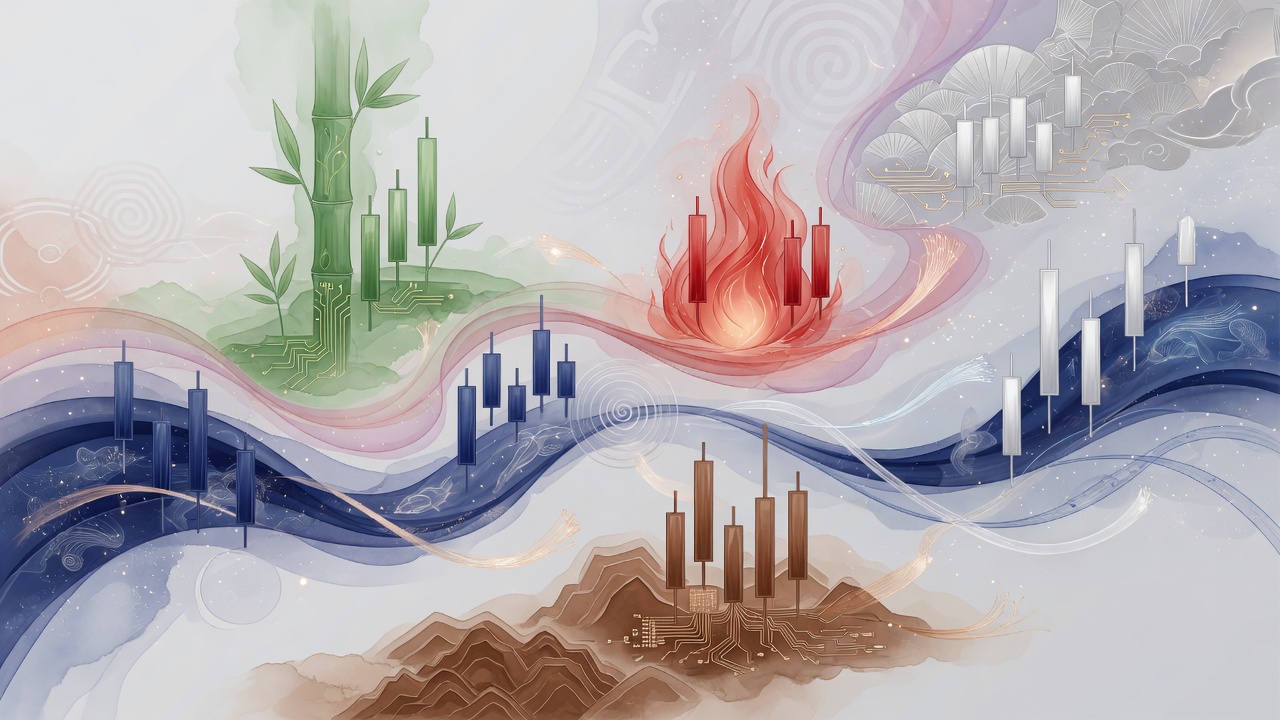
Analog Correspondences Between the Five Elements and Industries
Traditional Chinese metaphysics classifies all things into five categories, and industries can also be assigned to the Five Elements based on their nature and function. This classification is not rigid but captures core imagery, helping us understand the generation and restraint relationships between industries.
- Metal: Symbolizes rigidity and convergence, corresponding to finance, steel, precision machinery, automobile manufacturing, etc., carrying the power of severity and transformation.
- Wood: Symbolizes growth and flexibility, corresponding to agriculture/forestry, education, healthcare, environmental protection, textiles, etc., embodying the nature of expansion and stretching.
- Water: Symbolizes downward moistening and flow, corresponding to logistics, shipping, tourism, media, data, etc., possessing the function of penetration and dissemination.
- Fire: Symbolizes upward blazing, light and heat, corresponding to electronics, semiconductors, optoelectronics, internet, energy, etc., exhibiting explosive and accelerating dynamics.
- Earth: Symbolizes sowing and reaping, bearing and supporting, corresponding to real estate, infrastructure, cement, glass, ceramics, etc., embodying stability and harmony.
Generation, Restraint, and the Rhythm of Rotation
The Five Elements’ mutual generation (Wood generates Fire, Fire generates Earth, Earth generates Metal, Metal generates Water, Water generates Wood) depicts the logic of progressive industrial evolution. Mutual restraint (Wood restrains Earth, Earth restrains Water, Water restrains Fire, Fire restrains Metal, Metal restrains Wood) signals checks and balances after overheating.
- PCB sector (Fire) rotating to glass fiber fabric (Earth): Electronic components belong to Fire, while glass fiber fabric as a substrate belongs to Earth. Fire generates Earth, implying that upstream materials inherit downstream demand expansion — a natural extension of the generation chain.
- Transition from Earth to Metal: When Earth industries (e.g., glass, building materials) flourish, they often drive equipment, molds, and other Metal industries, reflecting the logic of Earth generating Metal. One can observe subsequent linkage in the equipment manufacturing sector.
- Warning of Water restraining Fire: If Fire (electronics) becomes overheated and encounters policy tightening or liquidity contraction (Water), then Water restrains Fire, potentially triggering a correction. Bazi emphasizes that “excess leads to harm; restraint brings balance” — excessive prosperity will naturally be balanced.
- Cycles are not linear: Actual rotation is influenced by many factors, but the Five Elements model reminds investors to pay attention to the generation relationships along the industrial chain and the restraint risks after excessive crowding, maintaining vigilance for contrarian thinking.
Personal Wealth Star Configuration and the Metaphor for Risk Appetite
In Bazi, the Wealth Star represents wealth opportunities and one’s attitude toward material resources. Its Five Element attribute and strength can serve as a metaphor for one’s risk appetite and suitable arenas. This is not fatalism but a cultural symbol for interpreting innate tendencies.
- Wealth Star as Metal (Direct/Indirect Wealth belongs to Metal): Metal represents righteousness. Such individuals are usually rational and decisive, adept at data analysis, with a natural affinity for finance and hard technology. Their risk appetite is moderate, emphasizing logic and discipline.
- Wealth Star as Wood: Wood represents benevolence. They tend toward steady growth investing, preferring education, health, and green industries. They are patient, can endure longer return cycles, and dislike short-term speculation.
- Wealth Star as Water: Water represents wisdom. They are flexible and adaptable, sensitive to liquidity, suited for fast-changing fields like trade, media, and data. Their risk appetite is higher but can be swayed by emotions.
- Wealth Star as Fire: Fire represents propriety. They are passionate and impulsive, with a strong interest in high-growth, high-volatility sectors like electronics, internet, and energy. They dare to chase highs but must guard against excess, needing Earth (stable allocation) to neutralize.
- Wealth Star as Earth: Earth represents trustworthiness. They are conservative and pragmatic, favoring tangible assets such as real estate, infrastructure, and commodities. Their risk appetite is low, pursuing long-term stable returns, but they may miss transformative opportunities.
- Wealth Star excessively strong or uncontrolled: Culturally, it metaphorically suggests that wealth overwhelms the self, making one prone to greed and risk. If the Wealth Star is weak and restrained, one needs the support of Companion Stars (Bi Jian) or Resource Stars (Yin Xing) (team, knowledge) to compensate, emphasizing the importance of one’s circle of competence.
Pitfall Avoidance Guide: Viewing Bazi and Investing Rationally
Important Notes
- Avoid rigid application: Five Element classification is a symbolic thinking method. The same enterprise may possess multiple elemental attributes. For example, Taiwan Glass belongs to Earth (glass) but also involves electronic-grade glass fiber fabric (a mix of Fire and Earth). Do not label it simplistically.
- Cycles are not absolute laws: Generation and restraint describe high-probability trends, not precise turning points. Markets are influenced by complex variables such as policy, technology, and sentiment. Bazi can only serve as a cultural reference.
- Do not replace risk control with Bazi: Even if one’s Bazi Wealth Star is strong, it does not guarantee investment success. Modern risk control measures such as stop-losses, position management, and diversification are the true foundations for protecting capital.
- Annual luck must be viewed dynamically: A personal chart changes over time. The intervention of Major Cycles (Da Yun) and Annual Cycles (Liu Nian) in the Five Elements may strengthen or weaken the Wealth Star. For instance, in a year of strong Fire, Fire-industry opportunities abound, but a person with a weak chart and strong Fire may easily suffer losses.
- Cross-verify information: If Bazi suggests a certain direction is favorable, one must still integrate fundamental, technical, and capital flow analysis for comprehensive judgment. Single-dimension decision-making carries extremely high risk.
- Cultural confidence, not superstition: Bazi is an ancient way of observing the world. Its value lies in providing a systematic thinking framework and cyclical awareness, not mystical prediction. Maintain a rational and critical spirit.
Summary and Review
From the PCB sector rotation triggered by Taiwan Glass’s surge, we used the Five Elements perspective of Bazi to interpret the internal logic of industrial mutual generation and restraint: the chain of Fire generating Earth explains why glass fiber fabric reasonably inherits electronic demand. Meanwhile, one’s personal Wealth Star configuration offers a cultural metaphor for risk appetite, reminding investors to know themselves and know the market — understand their own Five Element tendencies, combine them with modern analytical tools, and find a rhythm suited to themselves within the cyclical rotation. Ultimately, respecting the market, respecting cycles, and strictly adhering to discipline is the only true path through bull and bear markets.