From Nicholas Tse's Tears on Stage to Bazi Wisdom: Decoding Filial Piety and Family Destiny
In July 2026, Nicholas Tse held his concert as scheduled just days after the passing of his father Patrick Tse, choking back tears on stage. The moment "The show must go on" touched countless hearts. This is not just entertainment news—it is
Opening Introduction
In July 2026, Nicholas Tse held his concert as scheduled just days after his father Patrick Tse passed away, choking back tears on stage. The phrase "The show must go on" moved the entire audience.
This moment quickly trended in Singapore and elsewhere. People saw not only an artist's professionalism, but a profound expression of filial piety—using the performing spirit inherited from his father to pay the ultimate tribute.
In Bazi metaphysical culture, filial piety has never been an isolated code of conduct. It is a life philosophy closely linked to the family energy field and the foundation of personal destiny.
This article uses this trending event as a starting point, but without involving any personal natal chart privacy. It purely unpacks the deep coding of filial piety and family inheritance within the Bazi system from a traditional cultural perspective.
Basic Clarification: Bazi Is Not Fatalism, Filial Piety Is Not Superstition
Common Misconceptions
Many people, upon hearing the connection between Bazi and filial piety, assume that metaphysics is used to 'coerce' children into obedience or to calculate who clashes with whom. This completely deviates from the original intent of traditional destiny study.
- Misconception 1: Bazi determines whether one is filial or not. Destiny study never treats filial piety as a fated label. Instead, it views it as a virtuous energy that can be cultivated after birth, influencing one's blessed fortune.
- Misconception 2: A poor Parents Palace equals bad parent-child relationships. The Parents Palace (Year and Month Pillars) in Bazi reflects innate affinities and interaction patterns more than it does a rigid judgment of ethical quality.
- Misconception 3: Using filial piety as a pretext for remedies. True metaphysical culture emphasizes honoring heaven and ancestors, cultivating the heart and nature, rather than replacing actual filial conduct with feng shui objects.
Core Insights: Filial Piety and Family Inheritance in Bazi Culture
1. The Parents Palace: The Innate Foundation of Filial Piety
In Bazi destiny analysis, the Year Pillar represents ancestors and parents, while the Month Pillar represents parents and siblings. Together they are called the Parents Palace.
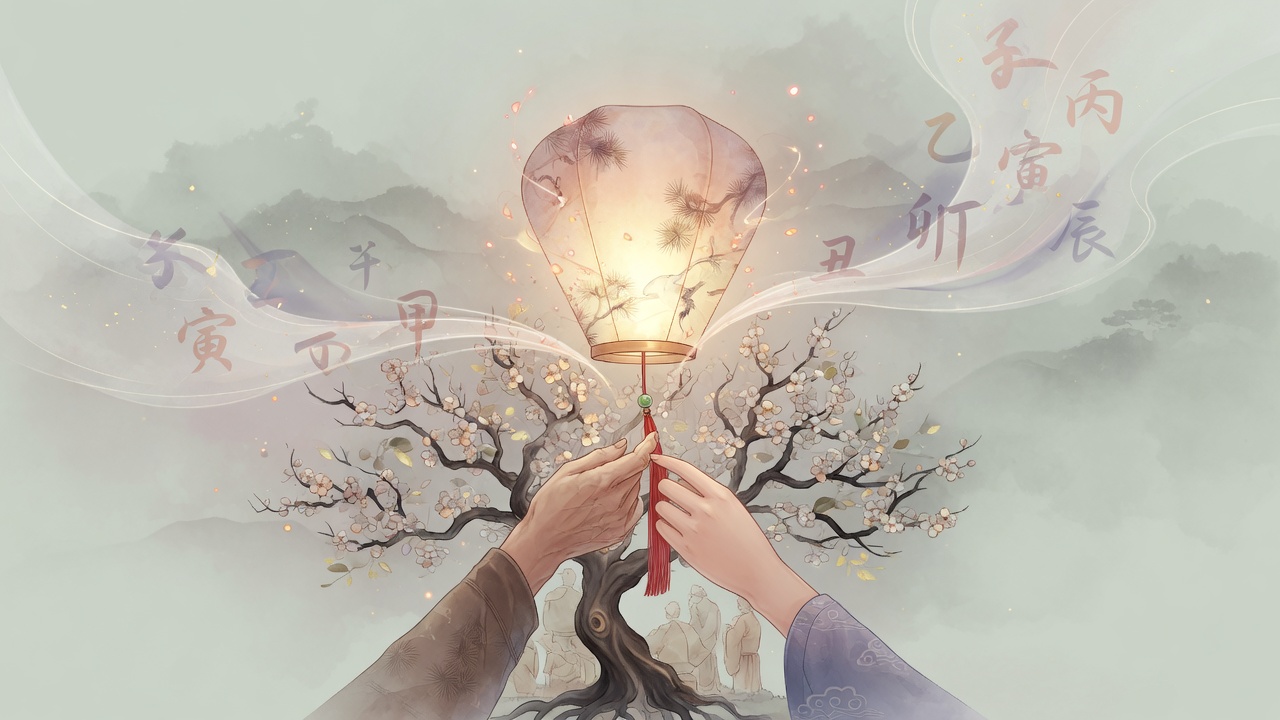
The Year Pillar is like the roots of a great tree; the Month Pillar is the trunk. Deep roots allow lush branches and leaves. The first layer of meaning for filial piety in destiny study is protecting the roots.
The ancients believed that a person's attitude toward their parents directly affects the energy flow of the Resource Star. The Resource Star governs protection, wisdom, and affinity with elders. Filial conduct activates the positive power of the Resource Star.
When a person sincerely practices filial piety, the favorable gods in their natal chart often receive corresponding support in reality. This is not superstition, but the resonance between one's heart-mind and the family energy field.
- Year Pillar as roots: A severely clashed or harmed Year Pillar often hints at weak ancestral shelter, but postnatal filial conduct can repair the foundation, just as adding soil and water to a tree.
- Month Pillar as trunk: The Month Pillar represents the core of the Parents Palace and reflects one's early growth environment. Honoring parents is essentially smoothing out the 'energy intake' of one's own natal chart.
- Resource Star and filial piety: The Direct Resource and Indirect Resource symbolize mother and elders. When the Resource Star is favorable and undamaged, it often brings elder support; if the Resource Star is unfavorable, filial conduct can transform karma, turning unfavorable into favorable.
2. The Transmission of Family Destiny and the Concept of 'Hidden Virtue'
Bazi culture never views personal destiny in isolation but places it within the long river of family. The good deeds or karmic debts of ancestors influence descendants through the principle of inherited burden, similar to intergenerational transmission in modern psychology.
The moment Nicholas Tse shed tears on stage is a concrete embodiment of this transmission. The acting career of his father Patrick Tse invisibly paved a certain destiny channel for the son.
The Bazi classic *Drip of Heavenly Essence* states: 'How do we know a person's longevity? Their original qi is solid. How do we know premature death? Their qi is turbid and spirit withered.' The turbidity or clarity of family qi is often related to the depth of filial virtue.
What is called hidden virtue is the invisible energy accumulated by ancestors quietly doing good without seeking reward. This energy can transform into Nobleman Stars or Blessing Stars in the descendants' charts, even altering the direction of their major cycles.
- The Law of Inherited Burden: The good deeds or evil deeds of ancestors ripple across generations like waves. Filial piety is precisely the key switch that blocks negative karma and enhances positive karma.
- Hidden virtue protects descendants: When a Bazi chart contains auspicious stars like Heavenly Yi Nobleman or Heavenly and Monthly Virtues, they are often interpreted as resulting from ancestral virtue, not mere random arrangement.
- Destiny channels: The industry parents engaged in and the connections they accumulated often resonate with the Wealth, Officer, and Resource stars in the children's charts. Filial piety can open this channel, making the transmission smoother.
3. How Filial Conduct Repairs Personal Destiny: A Look at 'Clashes and Afflictions'
In Bazi, clashes, punishments, harms, and restrictions are often used to describe disharmony in relationships. Among them, a clash between the Year Pillar and the Day Pillar often hints at shallow affinity with elders or tense parent-child ties.
But destiny study never tells people to resign themselves to fate. The ancients emphasized that 'one good deed dissolves a hundred disasters,' and one of the most direct good deeds is honoring parents. When a chart shows a Year-Day clash, filial conduct can become the most powerful mediating deity.
Nicholas Tse's perseverance in completing the performance amid the pain of bereavement is itself a ritual of mourning and a tribute to his father through action, invisibly repairing the energy rupture caused by life-and-death separation.
From a five-element perspective, filial piety belongs to Earth virtue. Earth governs trust, bearing, and transformation. Earth can generate Metal, and Metal is righteousness; Earth can control Water, and Water is wisdom. A person with deep filial conduct often has a stable temperament and a solid destiny foundation.
- Clashes and afflictions can be transformed: Year-Month clashes or Year-Day clashes are not hopeless situations. Through honoring parents and venerating ancestors, the force of the clash can be reduced, even turning danger into safety.
- Earth virtue carries all things: Filial piety corresponds to Wu and Ji Earth in the five elements. When Earth is thick, all things grow, and the carrying capacity of one's personal destiny is enhanced, avoiding dramatic ups and downs.
- The power of ritual: Traditional funerals, ancestral rites, and commemorative activities are, in destiny terms, rituals of energy field transition that help descendants complete the energetic handover, avoiding the long-term impact of 'deceased-parent affliction.'
Pitfall Avoidance Guide: Destiny Missteps in Practicing Filial Piety
Points of Caution
- Do not use Bazi to coerce family bonds: Never say things like 'your chart clashes with your father' to hurt family members. Bazi is a cognitive tool, not a weapon of attack.
- Filial conduct is not a transaction: Do not pretend to be filial just to change your luck. Without sincere intention, it is like soil without water—unable to generate genuine blessed fruit.
- Avoid over-interpreting celebrity charts: The actual birth times of Nicholas Tse and his father are not publicly available. Any online 'Bazi analysis' of them is pure speculation and should not be trusted.
- During mourning, stillness is preferable to movement: Traditional destiny study holds that during the period of new parental loss, a child's energy field is weaker. Major decisions like investments or weddings should be avoided; guarding oneself is a form of filial piety.
- Ancestral rites must not be neglected: Regular ancestral veneration is not only a folk custom but also, in destiny terms, a continuous connection to ancestral qi, stabilizing the foundation of one's Year Pillar—especially important for those with an Empty Death in the Year Pillar.
- Filial piety values substance over form: Companionship, listening, and respect activate the positive energy of the Resource Star far more than expensive gifts, because the Resource Star prefers stillness, affection, and genuine heart.
Summary and Reflection
The tears of Nicholas Tse flowed not only from the pain of losing a father but also from the collective resonance of filial inheritance in Chinese culture. Bazi destiny study encodes this ethical emotion into decipherable life patterns through symbols like the Parents Palace, the Resource Star, hidden virtue, and inherited burden.
True filial piety is not submission to fate, but aligning the human heart with the heavenly heart—using present good deeds to nourish the roots of the past and illuminate the road ahead. This is the warmest wisdom that Bazi culture leaves for future generations.