The Bazi Mystique Behind Emergency Landings: The Interplay of Character, Choice, and Destiny
Recently, a passenger plane bound for Israel experienced a rapid descent of 5,000 meters after the pilot allegedly attempted to crash, thrusting “emergency landing” into the global spotlight. In such a hair-raising extreme situation, an indiv
Opening Guidance
Recently, a passenger plane bound for Israel experienced a rapid descent of 5,000 meters after the pilot allegedly attempted to crash, thrusting “emergency landing” into the global spotlight. In such a hair-raising extreme situation, an individual’s character and immediate choices are magnified to the utmost.
From the perspective of Bazi destiny analysis, such stress-response patterns are not random but are deeply intertwined with the interaction of the Five Elements in the natal chart, the Ten Gods configuration, the strength of the Day Master, and the influence of Luck Cycles and Annual Stars. Using this event as a starting point, this article explains how Bazi interprets behavioral tendencies under high pressure, making no auspicious or ominous assertions about reality.
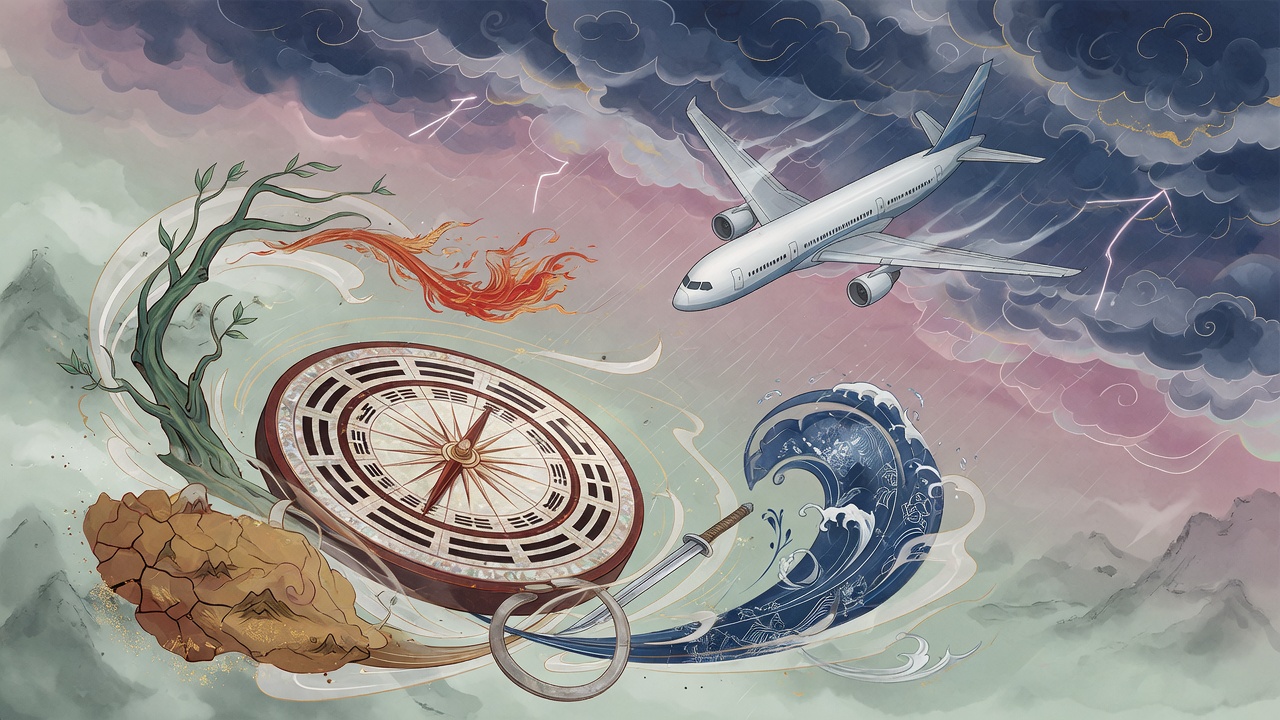
Basic Clarification: What Destiny Analysis Can and Cannot Do
Common Misconceptions
Before using an emergency event to discuss destiny analysis, we must first clarify the analytical boundaries of Bazi culture to avoid slipping into fatalism or reckless speculation.
- Misconception 1: Bazi can determine whether a person will commit extreme acts. In reality, Bazi only describes character tendencies and energy trends; it cannot predict specific actions, which are subject to free will and acquired cultivation.
- Misconception 2: Emergency events are entirely arranged by fate, and people have no subjective agency. Destiny studies emphasize the Three Realms of Heaven, Earth, and Humanity; personal choice and professional training are the decisive forces in critical moments.
- Misconception 3: Knowing a birth year is enough to analyze destiny. Accurate Bazi reading requires the complete Four Pillars (year, month, day, hour); missing any part renders the chart insufficient. Public information never provides an accurate time, so any specific reading about the individuals involved is groundless.
- Misconception 4: Equating metaphysical explanations with scientific causality. Bazi provides an image-and-number model for understanding the complexity of human nature, but it must not replace empirical investigations such as aviation safety inquiries.
Understanding Stress-Response Patterns from the Bazi Chart: How Inborn Codes Influence Emergency Decisions
Ten Gods Characteristics: Potential Behavioral Scripts
In Bazi, the Ten Gods are ten types of star deities determined by the relationship between the Day Stem and other Heavenly Stems and Earthly Branches. They represent different personality facets and social roles. In critical moments, different Ten God combinations produce vastly different stress-response scripts.
The following analysis is purely cultural education and does not target any individual. Through the Ten Gods, one can glimpse what kind of “default program” a person may trigger under immense pressure.
- Seven Killings (Indirect Officer): Bold and resolute, inclined to take high-risk measures in crises. If it is an unfavorable element and lacks restraint, it may evolve into aggressive or self-destructive tendencies. However, when properly controlled, it can transform adversity into authority, becoming an iron-fisted figure in a crisis.
- Hurting Officer: Extremely self-oriented, scornful of rules. When feeling constrained or oppressed, one may take drastic actions to break the situation, regardless of consequences. A person with a protruding Hurting Officer who lacks an Iindirect Resource star to restrain it may easily abandon standard procedures under high pressure.
- Direct Resource: Compassionate and conservative, tends to stabilize emotions and seek peaceful solutions in crises. The Resource star is the key to resolving the Seven Killings, able to turn danger into safety and rarely going to extremes.
- Rob Wealth: Impulsive and loyal, may make irrational decisions under group pressure or out of momentary passion during a collective crisis. If Rob Wealth is unchecked, one may act recklessly at crucial moments.
- Direct Officer: Values responsibility and order, typically remains calm in crisis. However, if the Officer and Killing stars are mixed, or if the Officer star is harmed, one may fall into a fierce tug-of-war between obedience to authority and personal will, delaying action.
Day Master Strength: Stress Threshold and Reaction Style
The Day Master is the Heavenly Stem of the birth day, representing the person themselves. The strength of the Day Master determines one’s threshold for stress. With different strengths, reactions in danger also differ greatly.
There is no absolute good or bad in strength; what matters is the Five Elements combination and whether there is a useful god effectively supporting the chart. However, in extreme events, the contrast between a weak and a strong Day Master is often strikingly evident.
- Strong Day Master: Like a thick dam, withstands pressure but may snap when over-rigid. If combined with Seven Killings and lacking control, may respond with violence against violence; if paired with Eating God to drain excess, one may calmly resolve the crisis.
- Weak Day Master: Like thin ice bearing a stone, usually hesitant and sensitive. Under sudden impact, emotional breakdown is highly likely. But if the chart has a close Direct Resource, one can harbor deep wisdom and find a sliver of calm amidst the chaos.
- Weak Day Master with strong Seven Killings and no control: A high-risk combination in Bazi; usually experiences heavy anxiety and oppression. When the Annual Star brings additional Officer or Killing, it may act like the last straw, inducing self-destructive or destructive thoughts. However, acquired cultivation and psychological resilience can greatly weaken such tendencies.
- Weak Day Master with protruding Hurting Officer: Overthinking, may exaggerate fear or take bizarre actions in a crisis. If there is a Direct Resource to control the Hurting Officer, rationality can be restored.
Five Elements Bias: Emotional Fuel and Triggers
Each of the Five Elements—Metal, Wood, Water, Fire, Earth—has its own emotional characteristics. Having one element excessively strong or excessively weak in the natal chart will dominate a particular emotional mode, acting as a hidden fuel driving behavior in a crisis.
Understanding your own Five Element bias helps you identify your emotional triggers during emergencies and proactively adjust.
- Strong Metal: Decisive and unyielding, calm but possibly cold. In an emergency, can make quick decisions, yet may also incline toward merciless detachment, ignoring humane considerations.
- Strong Wood: Benevolent and upright, but impulsive and rash. In danger, often acts based on moral principles, weighing pros and cons less, and may make tragic-heroic choices.
- Strong Water: Profound and intelligent, but can overthink. At a critical juncture, may calculate excesively and miss the moment, or fall into fearful fantasy.
- Strong Fire: Impatient and fierce, ignites at the slightest spark. In a fast-paced crisis, reacts swiftly, but lacks sustained calm and may explose emotionally under extreme pressure.
- Strong Earth: Steady as a rock, unflustered in crisis, but excessive conservatism may delay escape or cause slow adaptation to unexpected variables.
Luck Cycle and Annual Star: The Spatio-Temporal Key to Crisis Triggering
Even if the natal chart carries potential tendencies, they often remain latent energies without the activation of Luck Cycle and Annual Star. Emergency events frequently occur when the year's energies clash or harm the Day Pillar or the useful god.
This is like the relationship between a bullet and a trigger—the natal chart is the bullet, the luck cycle and annual star are the trigger; when the moment comes, the latent energy is released.
- Day Pillar Fu Yin (Same Year as Day Pillar): When the Annual Star is the same as the Day Pillar, such as a Jia Shen Day meeting a Jia Shen Year, it highly tends to trigger major life changes, including dangerous situations or identity transitions.
- Heavenly Clash and Earthly Punishment: When the Annual Star's Heavenly Stem clashes with the Day Stem and the Earthly Branch clashes with the Day Branch, e.g., Bing Zi Day meeting Geng Wu Year, energy is violently turbulent, easily inducing sudden accidents or impulsive decisions.
- Luck Cycle and Annual Star Identical: When the Luck Cycle and Annual Star share the same stems and branches, opportunity and risk arrive together, and one's behavioral boundaries may temporarily blur, leading to actions usually never taken.
- Useful God Damaged: When an element that plays a positive role is attacked, it can result in judgment errors. In high-stakes operations like piloting or medical work, a moment of confusion can cause an incident.
- Owl God Snatches Eating God (Indirect Resource overwhelming Eating God): Represents bocked thinking and dried-up inspiration; in an emergency, may experience brain fog or make mechanical errors.
Model Simulation: Stress-Response Deduction for a High-Pressure Bazi Chart
To illustrate the principles, let's construct a hypothetical Bazi chart (entirely unrelated to any real person or event) to show how Bazi can describe possible reactions under extreme pressure.
Suppose a person’s Day Master is Jia Wood, born in the month of Shen (Autumn), with Seven Killings in command, the Hour Pillar sees Si Fire (Hurting Officer), and the Year Pillar carries Ren Water (Resource). The original chart forms a Hurting Officer controlling Seven Killings structure, indicating exceptional capability and a tendency to act boldly in danger.
Assume the person enters a Ren Yin Luck Cycle, and the Annual Star encounters Geng Shen. The Luck Cycle’s Ren Water (Indirect Resource) emerges, creating Owl God Snatching Eating God, destroying the original control structure; the Annual Star’s Geng Shen (Seven Killings) strongly attacks the Day Master, and the Luck Cycle’s Yin branch and the Annual Star’s Shen branch form a Heavenly Clash Earthly Punishment, causing extreme energy turbulence.
At this point, if caught in an extreme environment, the Resource star is inhibited, the Hurting Officer is restricted, the Seven Killings attack the Day Master unchecked, easily generating dangerous thoughts or irrational decisions. However, if the chart also contains a strong Direct Resource, it can transform the Killings to nurture the Day Master, enabling adaptation in crisis and turning danger into safety.
- This deduction demonstrates precisely that character tendencies + luck cycle timing together draw the stress-response map, but it is not an unalterable fate.
- Acquired cultivation can greatly correct innate biases; nurturing the Direct Resource to resolve Killings, maintaining balance and harmony are effective ways to neutralize extreme tendencies.
- Bazi caution: When you realize you are in an emotional extreme or a luck-cycle low, take the initiative to pause high-risk decisions and seek professional support. Knowing fate without resigning to it—that is wisdom.
Pitfall Avoidance Guide: Boundaries When Using Destiny Analysis to Discuss Crisis Events
Cautionary Notes
When introducing a Bazi perspective into public events, we must strictly observe ethical boundaries, avoiding secondary harm to the parties involved and their families, and preventing misuse of metaphysical knowledge.
- Do not pronounce auspicious or ominous judgments based on news: Accurate Bazi analysis requires the complete Four Pillars; public reports never provide the precise birth time, so any specific conclusion about the individuals involved is baseless speculation.
- Bazi reveals tendencies, not deterministic outcomes: A person's final action is the interaction of countless variables—natal chart, environment, education, psychological state, professional training—and single-dimensional attribution is both irresponsible and unscientific.
- Maintain humanistic care: The focus of discussion should return to improving aviation safety systems and supporting crew mental health and other public topics, not to consuming the individuals' fates. Destiny enthusiasts should uphold the precept of no false speech, no exploitation.
- Object simplified attribution: Do not reduce a complex emergency landing event to labels like “it was fated” or “bad luck year.” This is both disrespectful to professionals and a distortion of Bazi culture.
- Enhance self-awareness, not judging others: The meaningful use of destiny studies is to understand your own stress patterns and emotional biases, awakening reason at critical moments. Do not trap others in the symbols of a birth chart.
- Practical advice for crises: If you feel you are in an emotional extreme or undergoing a turbulent luck period, voluntarily pause high-risk operations and seek peer support or professional intervention. Time and luck can wait; life cannot be restarted.
Recap and Reflection
What Bazi culture reveals is a complex map woven from character trends and luck cycles, never a mechanical fatalism. In extreme scenarios like an “emergency landing,” an individual's decision is indeed influenced by the chart's latent tendencies, but acquired cultivation, training, and crisis willpower are the key variables. Knowing your destiny is to better employ it, not to be trapped by it—to glimpse the abyss toward which you might slide, precisely so that at the decisive moment, you can pull back that control stick.