Disaster Energy and the Five Elements Balance: Understanding the 'Earth' Element in BaZi Tradition through Indonesia's 7.7 Magnitude Earthquake
On August 14, 2026, a 7.7 magnitude earthquake struck off the coast of Indonesia, triggering a tsunami warning and once again reminding us of nature's overwhelming power. In the five-element system of BaZi (Eight Characters) destiny analysis, earthqu
Introduction
A tsunami alert brought the shockwave of a 7.7 magnitude earthquake straight from Indonesia to our hearts. People wonder: why is nature so furious? In BaZi and Five Elements culture, this is not divine punishment, but a signal of imbalanced Heaven and Earth Qi. Ancient wisdom attributed earthquakes to a disorder of the Earth element—mountains shaking and land moving are precisely the moment when Earth energy releases violently. This article makes no disaster predictions; it merely interprets the logic of cosmic energy shifts and reflects on the personality mirrors cast by a strong or weak Earth element in a personal natal chart.
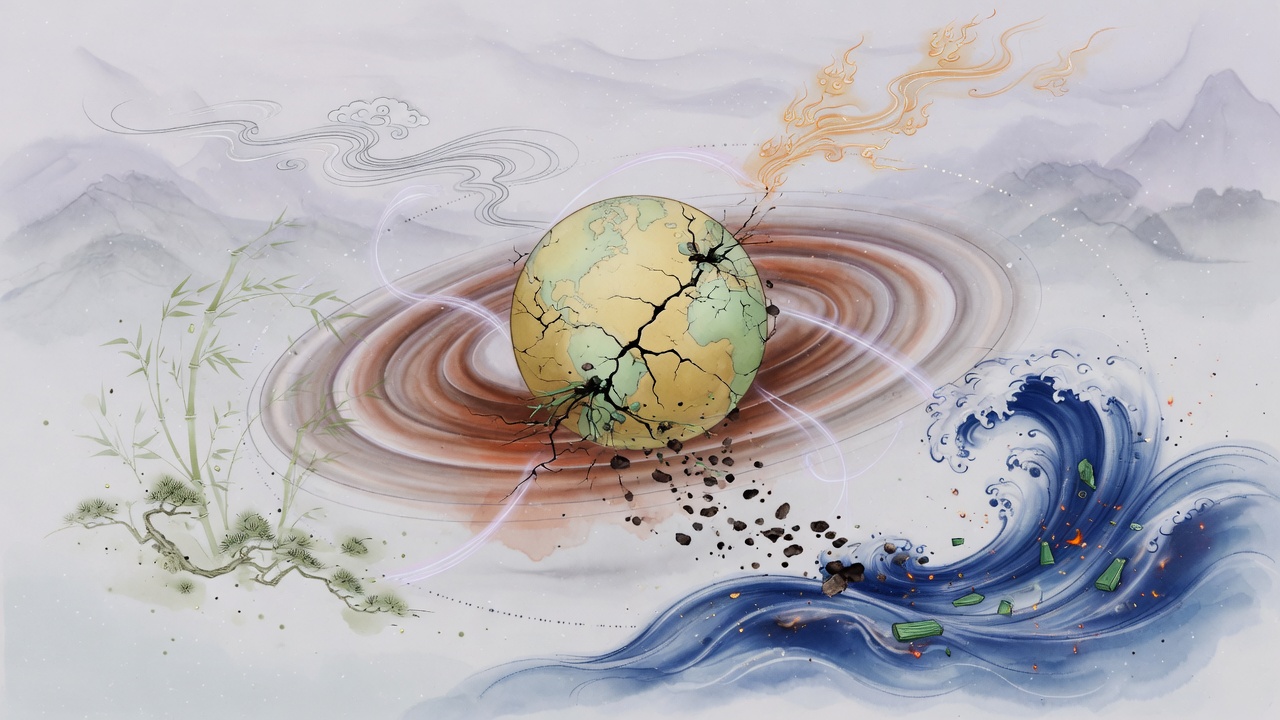
Clarification: Destiny Analysis Does Not Predict Disasters, It Observes Constant Energy Changes
Common Misconceptions
- Misconception 1: BaZi can precisely predict the time and location of earthquakes. In reality, BaZi studies the life rhythm of individuals, not tectonic plate movements. It does not have the technical capacity to forecast natural disasters. The ancients only used abnormal Five Element patterns to describe the symbolic meaning of 'earth movement.'
- Misconception 2: Seeing an earthquake means concluding that someone’s chart implies imminent disaster. Complex interactions exist between macrocosmic Qi and individual microcosmic luck; a direct causal link cannot be drawn. Destiny analysis emphasizes resonance of the same Qi—meaning large-scale environmental energy shifts may create a sense of resonance in those with sensitive constitutions or extremely unbalanced elements, rather than directly causing calamity.
- Misconception 3: An imbalanced Earth element is always negative. The Five Elements are in constant dynamic flow; imbalance and rebalancing are nature's norm. The ancients saw this as an expression of 'change,' focusing on observing its trends to provide a reference for personal physical and mental adjustment, not to define good or ill fortune.
Core Insights: From Five Elements to the Natal Chart – Decoding the Power of 'Earth'
Heaven and Earth Qi and the Circulation of Five Elements: Why Earthquakes Signal 'Earth' Imbalance
In traditional thought, the universe is composed of five fundamental energies: Wood, Fire, Earth, Metal, and Water. Their mutual generation and restraint maintain the dynamic balance of Heaven and Earth Qi. Earth sits at the center, governing transformation, bearing, and serving as the foundation for all growth. Solid mountains and silent ground are signs of smooth Earth Qi.
When internal geological energy accumulates to a breaking point, the bearing power of Earth is shattered, causing tremors. The ancients called this the Earth Dragon turning over, corresponding in the hexagram system to the abnormal change of the Kun trigram (pure Yin Earth). The *Yellow Emperor's Inner Canon* also states that when 'Earth depression' erupts, mountains and rivers collapse. So an earthquake is not an invasion by an external force, but a violent expansion and loss of control within the Earth element itself.
A tsunami can be understood as the fierce counterattack of the Water element after losing Earth’s restraint, following the shock of Earth energy. In the Five Elements, Earth restrains Water; under normal conditions, Earth can control Water, keeping the ocean calm. An earthquake breaks this restraining structure, causing Water to surge skyward in a chain reaction of energy release. Thus, ancients often paired earthquakes and tidal waves, essentially describing an extreme state of conflict between Earth and Water.
- Earth element in balance: carries, stabilizes, trustworthy; mountains stand firm, land is at peace
- Earth element overactive: stagnates, shakes, collapses; mountains tremble, the Kun axis loses guard
- Implicated Water element: if Earth cannot restrain Water, floods and tsunamis arise, showing an inversion of the restraining force
- Classical corroboration: *The Great Meaning of the Five Elements* states, 'When Earth loses its nature, there are earthquakes and overflowing rivers,' directly pointing to the cause and effect
Personality Traits from the Natal Chart: Overly Strong vs. Overly Weak Earth
BaZi records time with Heavenly Stems and Earthly Branches, where Earth corresponds to the stems Wu (戊) and Ji (己), and the branches Chen (辰), Xu (戌), Chou (丑), and Wei (未). The quantity and configuration of the Earth element in a chart shape a person's innate temperament and behavioral patterns. Although a natal chart has no direct physical link to the earth shaking, there is a fascinating resonance on the level of elemental character.
For overly strong Earth: charts often contain multiple Chen-Xu-Chou-Wei branches, or overlapping Wu and Ji stems without Wood to loosen the soil. Their personality is as solid as the earth, but they tend to be overly conservative and stubborn, inflexible when faced with change. When the external environment is also saturated with Earth Qi, they easily feel oppressed and listless, acting without adaptability—as if 'a foundation too solid becomes brittle.'
For overly weak Earth: charts lacking Wu or Ji Earth, or without Chen-Xu-Chou-Wei branches, or where Earth is completely overcome by Wood. These individuals lack a sense of grounding, appearing drifting and unstable, prone to credulity and dependency, like a building without a firm foundation. When encountering years dominated by surging Water, their sense of security is further eroded and their emotions fluctuate—sharing a rationale with the tsunami imagery where 'without Earth to control, Water runs wild.'
- Strong Earth traits: highly patient, trustworthy, commitment-oriented, but averse to movement, weak adaptability, prone to stubborn fixation
- Weak Earth traits: flexible and adaptive, but easily distracted, likely to give up halfway, and their reliability can be shaken by circumstances
- Key balancing factors: strong Earth benefits from Wood (Jia, Yin) and Metal (Shen, You) to drain and disperse; weak Earth benefits from Fire (Bing, Si) and Earth (Wu, Chen-Xu) to nourish and support
- Case pattern: Those with consolidated Earth and scarce Wood may undergo dramatic transformations when meeting a Wood-heavy year as it 'activates' their chart; those with weak Earth, when encountering Fire and Earth luck cycles, often seize opportunities to stabilize their career
Shifts in Space-Time Energy: 'Earth' in Luck Cycles and Personal Sensitivity
BaZi examines not only the natal chart, but also Major Luck (Da Yun) and Annual Luck to calculate the energy themes at different life stages. When encountering strong Earth stem-branch combinations (such as Wu-Xu, Ji-Wei, or Chen-Xu years), the external macro Qi resonates with the native Earth element, making strong-Earth individuals more prone to obstinacy, while weak-Earth individuals may gain temporary reinforcement.
Similarly, when a year brings powerful Wood (e.g., Jia-Yin, Yi-Mao years) that specifically controls Earth, those with a strong Earth chart may feel long-suppressed pressure finally release and experience a surge in action; those with weak Earth may become even more scattered. This aligns with the chain of restraining forces seen after an earthquake and tsunami—Wood restrains Earth, Earth fails to restrain Water—following exactly the same Five Elements logic. Traditional practitioners observed such rhythms in individual emotions and decision-making, not to predict fortune or misfortune.
For instance, in a strong Earth/Metal autumn (Shen-You-Xu forming Metal, Chen-Xu-Chou-Wei receiving Earth Qi), if one’s chart suffers from excessively dry Earth, it is advisable to increase calming activities to avoid interpersonal 'earthquakes' caused by stubbornness. For a weak Earth with strong Water chart, engaging in grounding practices and adding stability may help prevent being easily overturned by external turbulence. These adjustments are essentially a way to approach harmony and avoid extremes by understanding the seasonal rhythm of the elements.
- Annual Luck reference: In combinations like Wu-Xu, Ji-Hai, or Geng-Zi, the nature of Earth differs (dry earth vs. wet earth), leading to varied resonance effects
- Not disaster prediction: Observe only internal tendencies—e.g., when Earth meets more Earth, excessive brooding is likely; actively seek relief
- Using the Five Elements: For weak-Earth individuals stirred by earthquake or tsunami news, wearing yellow accessories or spending time in earthy environments can help calm the mind—this is a cultural and psychological self-soothing practice, not sorcery
Guidance: Taking a Rational View of Destiny Analysis and Natural Events
Keep in Mind
- Don’t treat destiny analysis as a seismograph: The Five Elements model is a cultural symbol for interpreting the human-cosmos relationship, without the predictive function of modern science. Any claim of using BaZi to foretell earthquake timing or magnitude distorts tradition.
- Avoid causing anxiety by taking it personally: After reading news about earthquakes and tsunamis, don’t blindly check whether your Earth element is strong or weak and conclude 'I am in danger.' There is no linear correspondence between an individual chart and large-scale natural disasters; energetic resonance is only an extremely faint potential connection.
- Neither strong nor weak Earth is inherently better: The Five Elements only vary in balance and circulation; there is no absolute superiority. Strong Earth may confer perseverance, while weak Earth grants agility. What matters is whether one can adjust accordingly. Do not label or limit yourself based on destiny analysis.
- Do not ride unverified hot topics: Content such as 'a certain chart type is fated to encounter tsunamis' easily causes panic. We discuss only the general philosophy of the Five Elements, not individual destiny, and must never use disaster scenarios to frighten readers.
- Traditional culture is wisdom, not a magic charm: Studying the Five Elements is meant to help understand the systemic and balance-oriented worldview of ancient observers. Use it as a window to broaden insight, not as a superstitious ritual to ward off calamity—that is true cultural confidence.
Summary & Reflection
From the tsunami alert triggered by the 7.7 magnitude earthquake in Indonesia, we trace back to the source of BaZi tradition and the Five Elements: the imbalance of the Earth element was the core logic ancient sages used to explain ground shaking and mountain splitting; the conflict between Earth and Water painted a macroscopic picture of cascading disorder. Projecting this onto the personal natal chart, those with overly strong Earth gain insight into the path of flexibility, while those with overly weak Earth learn the importance of groundedness. All of this is not meant to foretell calamity, but to reflect, through nature’s great upheavals, on the beauty of centering harmony in individual life—stability without rigidity, flow without dispersal—the deepest lesson left by the philosophy of the Five Elements.