From Kanagawa Joint Disaster Drill to Bazi Five Elements: Foresight in Safety is the Deepest 'Firewall' in Destiny Analysis
In autumn 2026, Kanagawa and eight other prefectures and cities in Japan conducted a large-scale joint disaster drill, simulating a mega-earthquake and strengthening cross-regional coordination. On the surface, this modern drill is emergency prep
Opening Introduction
When the alarms sounded in Kanagawa and other areas, nine prefectures and cities swiftly entered coordinated response to a simulated mega-earthquake. This drill was not just an administrative procedure, but a collective act of “preemptive risk removal.” In Bazi theory, Five Elements imbalance itself symbolizes disaster, and Heaven–Human Resonance reminds us: active human prevention is itself a positive harmonization of the cosmic qi.
Basic Clarification: Bazi Is Not a Disaster Prediction Tool
Common Misunderstandings
- Myth 1: Bazi can precisely predict the time and place of earthquakes, floods, and other disasters. In reality, Bazi reveals the interaction pattern between an individual's chart and the environmental qi field, not a forecast of specific events. It focuses on “tendency” rather than “incident.”
- Myth 2: Heaven–Human Resonance is a superstitious belief in “divine punishment.” In traditional destiny study, Heaven–Human Resonance is essentially a systems view, holding that natural rhythms and human social behavior resonate with each other, and that human prevention and moral cultivation can influence the direction of qi, akin to the modern concept of “resilience building.”
- Myth 3: “Foresight in safety” is just moral preaching unrelated to destiny. In the Bazi system, the changes of major cycles and annual influences are like the rotation of seasons; calm often conceals clashes and constraints. Knowing how to prepare in advance is following the rhythm of Five Elements flow, avoiding the shock of “suddenly entering a crisis.”
Core Points: Five Elements, Heaven–Human Resonance, and the Destiny Logic of Disaster Prevention
1. Five Elements Imbalance: Observing Environmental Qi Changes from Earth Tremors
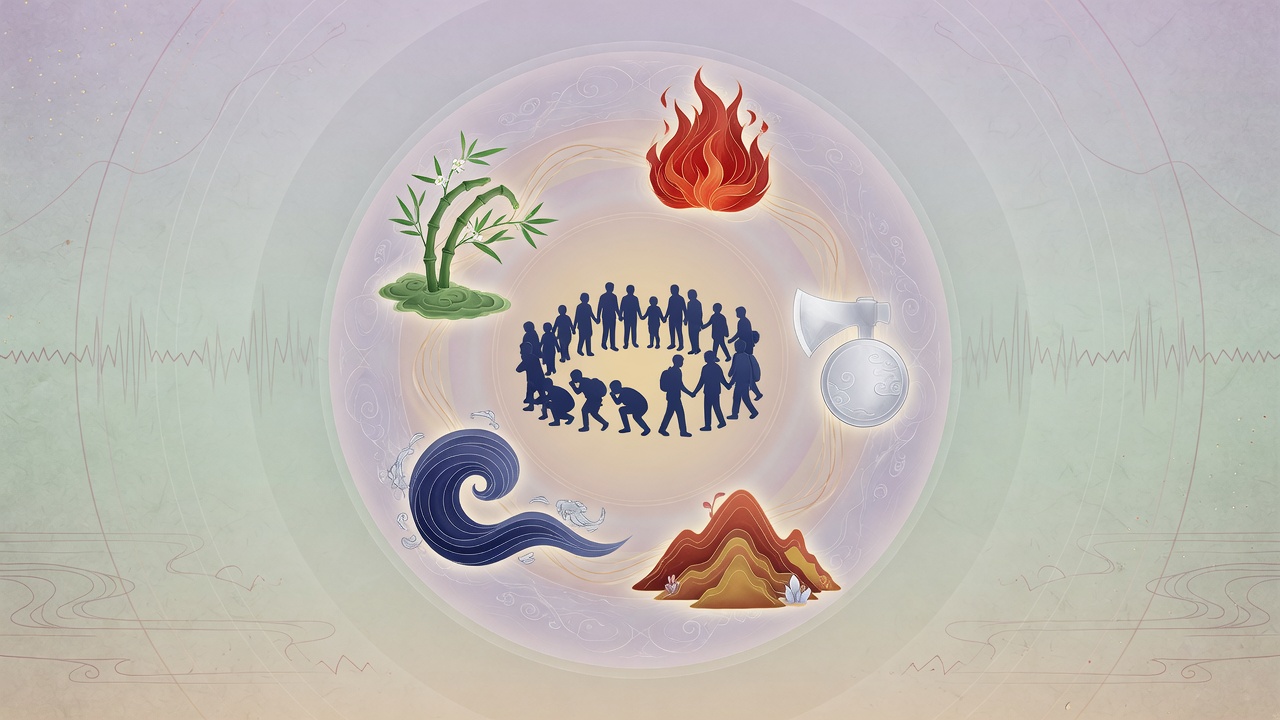
The foundation of Bazi theory is the generating and overcoming cycles of the Five Elements (Wood, Fire, Earth, Metal, Water). Earth governs bearing and stability, corresponding to the virtue of Kun. When Earth is overcome by Wood, or when Water erodes Earth, signs of unstable ground, landslides and collapses often appear. In destiny imagery, earthquakes are often attributed to severe Earth imbalance, a departure from the harmonious qi of thick Earth.
But Bazi does not directly discuss earthquakes; instead, it warns of environmentally sensitive periods through stem-branch clashes and combinations. For example, when a yearly cycle features Wood–Earth conflict (strong Wood overcoming weak Earth), or Earth mixed with Water, it often indicates that the earth's qi is unstable during that period, and people should heighten their awareness of prevention. The observations of ancient geomancy and imperial astronomers were precisely long-term summaries of such Five Elements anomalies.
- Robust Earth: Thick Earth supports all things, representing stability and bearing capacity, corresponding to building foundations and psychological security.
- Wood–Earth conflict: Yi Wood overcoming Wu Earth, or Jia Wood overcoming Ji Earth; if triggered by a yearly cycle, it signals turbulent ground energy, with potential risks of subsidence and tremors.
- Earth mixed with Water: Weak Earth meeting strong Water, such as Ren Water rushing against Wu Earth, indicates unstable foundations and risks of mudslides, requiring attention to mountainous areas and riverbanks.
- Modern insight: The mega-earthquake simulated in joint disaster drills is a collective, preemptive response to “Earth imbalance,” much like detecting upcoming clashes in a destiny chart and proactively reinforcing one's own “levee.”
2. Heaven–Human Resonance: Disaster Drills as Collective “Qi Field Harmonization”
“Heaven–Human Resonance” is not a simple cause-and-effect retribution, but emphasizes that human beings and nature are intertwined. In the Han dynasty, Dong Zhongshu systematized this idea, arguing that when human affairs are neglected, disasters appear; conversely, collective reverence and preparedness can “turn calamity into blessing.” This thinking is the cultural prototype of modern disaster drills.
In Bazi, there is a resonance between an individual chart and the macro-environmental qi field. When a group jointly conducts a disaster drill, it is essentially injecting an orderly “Metal” qi (solemnity, retraction, preparedness) into the collective consciousness, to restrain potential “Earth disorder.” This orderly preventive energy can balance chaotic qi fields.
The joint drill across nine prefectures and cities in Kanagawa is a modern practice of this Heaven–Human Resonance: by simulating disaster, the social system enters a “response-ready state” in advance, so that when a real disaster strikes, the disorderly release of energy is reduced. This is akin to transformation combinations in destiny—turning the force of clashes into organized response.
- Metal qi governs defense: Metal in the Five Elements represents retraction, solemnity, and discipline. Disaster drills strengthen the society's “Metal” nature, reducing chaos.
- Earth generating Metal: Earth produces Metal. Stable Earth (infrastructure) combined with orderly Metal (emergency mechanisms) can mitigate the impact of ground motion.
- Collective intent: The cross-regional linkage of nine prefectures and cities forms a collective energy field, similar to a “combination” in a Bazi chart, enhancing overall resilience against disasters.
- Cultivating virtue to respond to Heaven: Ancients believed the highest level of disaster prevention is “virtue overcoming calamity”—using human ethical order and preventive measures to minimize the destructive power of natural disasters.
3. Foresight in Safety and Preparing Before the Rain: The “Defensive Forecasting” in Bazi Wisdom
“Foresight in safety” comes from Zuo Zhuan, and “preparing before the rain” from the Book of Songs. They are not just philosophies of life, but also align with the underlying logic of Bazi analysis. After a Bazi chart is drawn, the practitioner pays special attention to the clashes and combinations brought by major cycles and annual influences—this is essentially a forward-looking defensive mindset.
For example, a person with weak Earth in their chart, when encountering a strong Wood year, should be mindful of environmental changes caused by Wood–Earth friction. Ancient advice would include avoiding dangerous areas and reinforcing houses. This mentality of “knowing in advance and preparing in advance” is exactly the same as modern earthquake early warnings and disaster drills—both are based on understanding patterns to minimize harm.
The joint drill in Kanagawa, Japan, is the ultimate expression of preparing before the rain: knowing that earthquakes cannot be accurately predicted, yet through periodic drills, turning muscle memory and system response into a “second instinct.” This is like cultivating the favorable god in a Bazi chart—by strengthening the helpful elements in ordinary times, one gains resistance when the unfavorable cycles arrive. Disaster drills are society's “nurturing the favorable god.”
- Major cycle and annual influence perspective: The core of Bazi forecasting is assessing the flow of energy; disaster drills are like identifying an upcoming “unfavorable cycle” and arranging mitigation in advance.
- Using the favorable to guard against the unfavorable: The favorable god is the element that balances the chart. In social disaster prevention systems, early warning mechanisms, emergency supplies, and drill experience are the public safety “favorable gods.”
- Crisis awareness: In destiny, there is no “permanent peace,” only “dynamic balance.” The same applies to society: continuous disaster drills maintain this dynamic balance.
- Cultural psychology: Japan, deeply influenced by traditional Chinese culture, has a collective consciousness of “preventing before it happens” that highly resonates with the “foresight in safety” thinking of the I Ching. Joint drills are a modern expression of this cultural gene.
Avoidance Guide: How to Rationally View the Relationship Between Bazi and Disaster Prevention
Key Precautions
- Do not treat Bazi as a disaster prediction machine: An individual chart can only reflect environmental sensitivity; it must never replace geological monitoring or official warnings. Do not use Bazi to counter modern scientific disaster prevention systems.
- Avoid a fatalistic passive mindset: Even if your chart shows weak Earth facing clashes, you must not abandon active prevention. Bazi emphasizes “seeking advantages and avoiding disadvantages,” not resignation. Disaster drills are the best way to seek advantages.
- Collective prevention outweighs individual fortune-telling: In the face of major disasters like earthquakes, orderly collective response is far more effective than personal divination. Do not neglect community drills and evacuation routes because of an interest in destiny studies.
- Respect cultural differences but remain rational: Japan's joint drills embody scientific emergency management plus cultural awareness. We should learn from the form, but more importantly understand the underlying spirit of “foresight in safety,” rather than blindly superstition.
- Daily application of Five Elements balance: You can achieve psychological calm by adjusting Earth elements at home (such as ceramics, yellow decorations), but never underestimate building seismic standards; physical defense is always the first line of protection.
- Beware of “disaster removal rituals” as scams: Anyone charging high fees in the name of “resolving earth-movement calamities” is committing fraud. The true pre-disaster resolution is cultivating virtue, preventing harm, and mutual help.
Summary and Review
The joint disaster drill of Kanagawa and eight other prefectures and cities is a modern echo of the wisdom of foresight in safety. From the perspective of Bazi's Five Elements, earthquakes are Earth imbalance, and disaster drills are Metal qi's solemn defense; from Heaven–Human Resonance, collective drills are responding to natural changes with human harmony. Traditional destiny study never places humans in a passive role; instead, it emphasizes proactive action within dynamic balance. The best “feng shui” is always advance preparation and reverence for nature.