From Claude to Bazi: Eastern Wisdom on Character, Choice, and Timing in the AI Era
As Claude and ChatGPT begin watermarking text, we stand at a pivotal juncture in the reshaping of human-machine relationships. Amid surging technological tides, how should individuals navigate? South Korea’s heightened attention to AI ethics reflects
Introduction
In October 2026, Claude and ChatGPT successively announced plans to add watermarks to text, with the EU as the first region for implementation. This is not just a tech news item; it marks a watershed moment: when machine-generated content must be labeled, human originality and autonomous choice are thrust back into the spotlight.
South Korean public opinion responded swiftly, with search interest soaring, reflecting a collective contemplation on AI ethics, identity recognition, and future ways of living. Bazi, as an Eastern cognitive system, happens to offer a millennia-old observational model precisely on the triangular relationship between character, timing, and decision-making.
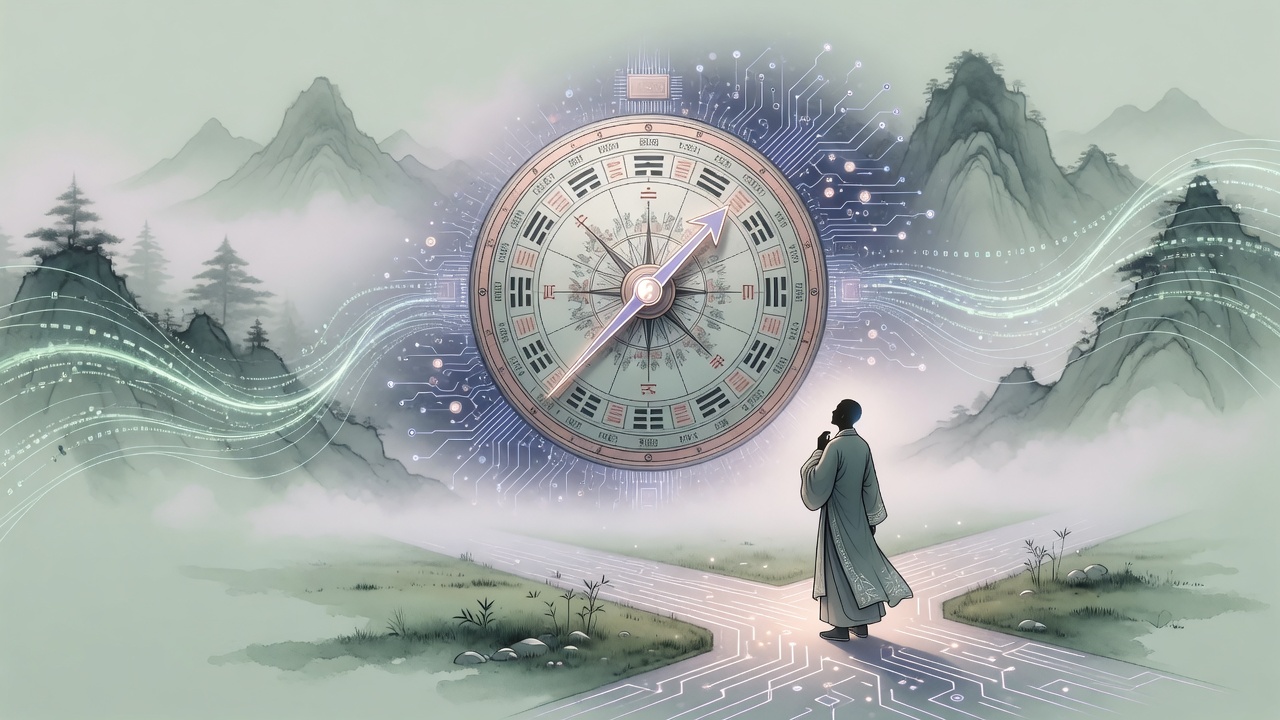
Clarifying the Basics: Bazi Is Not a Fatalistic Calculator
Common Misconceptions
- Misconception 1: Bazi determines everything. In reality, Bazi reveals innate energy tendencies and potential trends, much like providing wind direction and ocean currents—the ship’s navigation still depends on the helmsman.
- Misconception 2: The same Bazi chart leads to the same destiny. Even individuals born at the same hour can have vastly different life paths due to differences in geography, family background, and acquired choices. Bazi provides a framework, not a script.
- Misconception 3: Bazi is only for fortune-telling. The core function of traditional destiny study is self-knowledge—understanding one’s strengths and blind spots to optimize decision-making, akin to self-awareness in psychology.
- Misconception 4: AI can accurately calculate Bazi. AI can quickly generate charts and apply rules, but it cannot replace a practitioner’s intuitive grasp of structural configuration and energetic climate, nor can it comprehend the complexity of specific life contexts.
Core Insights: The Bazi Dialectic of Character, Timing, and Choice
1. How Bazi Depicts the Underpinnings of Character
The Day Master (the Heavenly Stem of the birth day) represents the self, and its Five Element quality already sketches a basic temperament: Jia Wood grows upward and often carries a sense of responsibility; Bing Fire is warm and exuberant, with strong contagious energy; Geng Metal is resolute and decisive, with clear boundaries.
But character is never a single label. The Month Branch (the Earthly Branch of the birth month) determines the structural tone, much like stage lighting, causing the Day Master’s traits to manifest differently under varying circumstances. The same Jia Wood, born in spring when it is in season, appears expansive and magnanimous; born in autumn when it is out of season, it may become more introverted and resilient.
The Ten Gods system further refines character facets. Direct Officer values rules and order, Eating God governs creative expression, and Seven Killings brings boldness and a sense of crisis. These configurations are not about good or bad; they constitute each person’s unique decision-making style—some think thrice before acting, others are driven by intuition.
- Day Master Five Element: Wood governs benevolence, Fire governs propriety, Earth governs trustworthiness, Metal governs righteousness, Water governs wisdom—these provide basic character archetypes.
- Month Branch strength or weakness: Determines energy level, influencing confidence and modes of action.
- Ten Gods combinations: For instance, Officer-Seal inter-promotion indicates steadiness and orderliness; Eating God producing Wealth indicates flexibility and adaptability.
- Five Element circulation: Whether the Five Elements in the chart cyclically generate each other relates to emotional stability and adaptability.
2. Luck Cycles and Annual Influences: The “Timing” Background We Cannot Choose
In Bazi theory, Luck Cycles (大运) shift every ten years, and Annual Influences (流年) change each year, forming the temporal field that individuals cannot control. This closely resembles the tides of an era: the rise of AI, economic cycles, social changes—none can be reversed by a single person’s effort.
Yet timing is not fatalistic. The same unfavorable annual influence may force one person to transform through clashes and ultimately open new horizons, while another clings to old patterns and feels stifled. Bazi emphasizes going with the flow: advance actively when the momentum is high, and cultivate introspection when the momentum is low.
The key lies in the Useful God (用神) as a regulator. The Useful God is the pivot that balances the chart’s temperature, moisture, strength, and weakness. When a Luck Cycle or annual influence activates the Useful God, it becomes a window for personal resonance with the times; conversely, one should use stillness to counter movement, avoiding exhausting counter-trend struggles.
- Luck Cycles: The ten-year theme color, reflecting periodic opportunities and challenges—for example, a Seal cycle in youth favors learning, a Wealth cycle in midlife suits expansion.
- Annual Influences: Yearly variables that trigger specific event threads, but outcomes depend on personal choice and preparation.
- Useful God: The balance point of the chart; finding one’s “optimal support direction” helps anchor one’s center in turbulent times.
- Going-with-the-flow example: If the chart favors Fire, actively learning and networking during Fire years often yields twice the result with half the effort; resisting the trend leads to half the result with twice the effort.
3. Implications of the AI Watermark Era from a “Timing” Perspective
The watermark policies of Claude and ChatGPT are essentially new rules brought by technological evolution. From a Bazi perspective, this belongs to a shift in annual energetic climate—societal transparency is rising, and original value is being re-emphasized.
For individuals, this is not a good-or-bad event but a structural adjustment. Those whose charts emphasize the Seal star (knowledge, certification) and Eating God / Hurting Officer (creativity, expression) may be the first to sense the environment’s call for originality and thus proactively strengthen their unique output.
If the original chart has strong Officer / Killings (high sensitivity to rules), the watermark era may feel like a fish in water, because clarified rules make the boundaries of action clearer. Bazi reminds us: timing has no fixed good or bad; the key is whether it matches one’s own traits.
This mindset aligns with the current emphasis on “AI ethics” in South Korea—not opposing technology, but understanding trends and then making differentiated choices based on one’s own positioning. The Bazi model provides exactly this interactive framework of “positioning—trend.”
- AI watermarks: The embodiment of societal timing, pushing content production from “quantity” back toward “quality.”
- Personal alignment: Those with strong Eating God / Hurting Officer should delve into creativity; those with strong Officer / Seal can participate in rule-making; those with strong Peer star need to strengthen collaborative networks.
- Dynamic adjustment: There is no eternal good or bad luck, only a continuously calibrated life algorithm.
- Eastern wisdom: Bazi does not predict outcomes; it only reveals energy distribution. The power of choice always remains in human hands.
Avoiding Pitfalls: Applying Destiny-Thinking Rationally
Points to Note
- Do not treat Bazi as the sole basis for decisions. It is suitable as a tool for self-awareness; major choices still require integrating real-world information, professional advice, and rational analysis.
- Beware of AI fortune-telling traps. Although current AI chart generation is fast, it lacks deep understanding of structural intention and stem-branch combinations and transformations, making results prone to mechanization and out-of-context interpretation.
- Avoid self-labeling. For example, concluding “I have uncontrolled Seven Killings” and resigning oneself to aggression. In reality, Bazi emphasizes proper regulation and transformation; acquired cultivation can transform innate biases.
- Avoid rigid interpretations of timing. The same watermark policy affects different industries and individuals with different chart structures in vastly different ways; one cannot apply a one-size-fits-all good-or-bad judgment.
- Choose practitioners carefully. Truly professional ones emphasize possibilities rather than inevitabilities, and guide you to see the space for choice rather than creating fear and dependency.
- Special note for Korean users: Bazi is rooted in the Chinese Yin-Yang and Five Element system. It shares origins with Korea’s Saju (사주) but differs in terminology. When studying, trace the underlying principles and avoid being misled by commercial packaging.
- Use Bazi thinking to understand the AI era: Technological iteration is like Luck Cycle transitions. Instead of worrying about being replaced, examine your own Five Element configuration and discover the unique value that algorithms cannot easily replicate.
Summary and Reflection
The Claude watermark incident is merely a trigger, prompting us to reconsider: in the torrent of technology, how is choice possible? The answer Bazi culture offers is simple yet powerful—recognize your character’s underpinnings, sense the rhythm of the times, and then respond with clear self-awareness.
True Eastern wisdom has never been about predicting the future, but about understanding the present. When you comprehend your own energy tendencies and the phase you are in, you can transform passive adaptation into active creation in the face of new rules like AI watermarks.