Chongyang Festival, Yin Star, and Filial Piety: Understanding Festival Date Selection and Family Fortune through Bazi
On October 17, 2026, the Chongyang Festival, search interest in Taiwan surges, reflecting a deep cultural need behind the custom. This article approaches the topic through Bazi destiny analysis, rationally examining how the tradition of honoring
Opening Introduction
Customs such as climbing heights, honoring elders, and wearing zhuyu (cornus) during the Chongyang Festival have been passed down for thousands of years and hold deep roots in Taiwanese society. When we explore why these rituals are closely tied to filial piety, the concept of the Yin Star in Bazi theory offers a unique rational perspective: it is not merely a destiny symbol, but also represents a traditional cognitive system concerning energy transmission, family protection, and temporal rhythms.
This article will start from the temporal attributes of the Chongyang Festival, combining traditional date selection studies and Bazi Yin Star theory to explore the logical thinking behind festival customs, helping readers understand how this cultural wisdom can gain new interpretations in contemporary life.
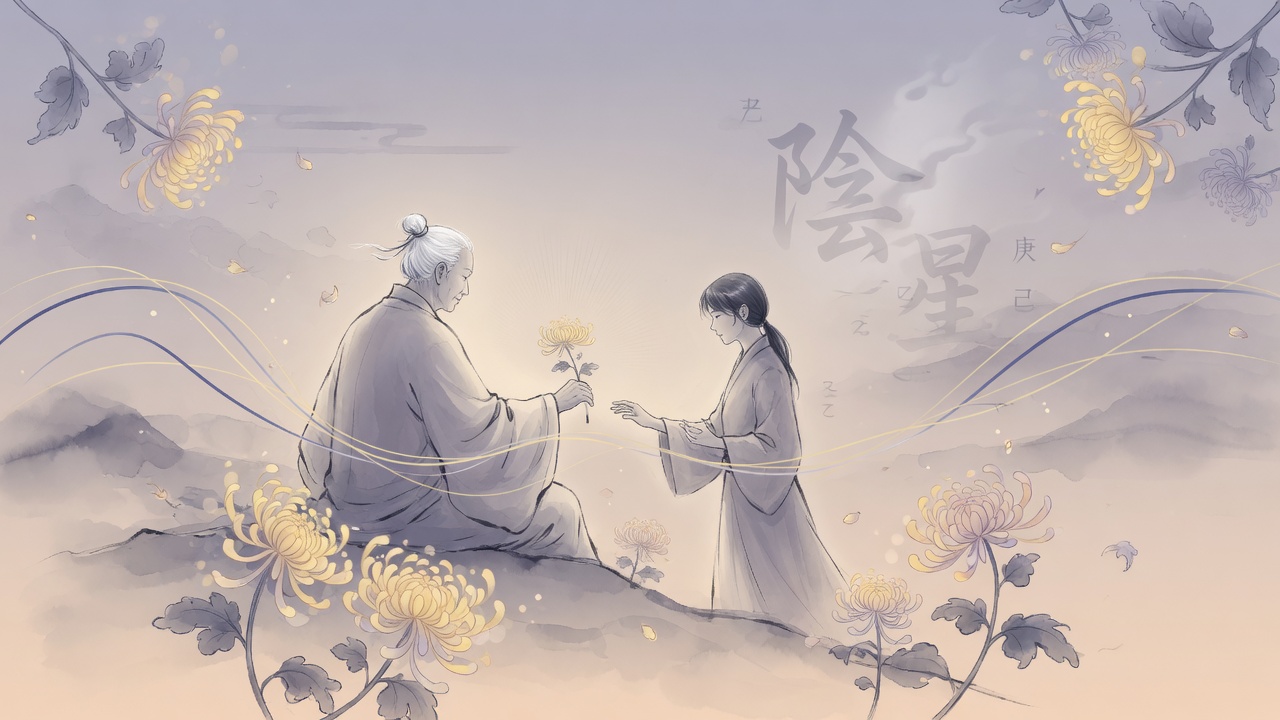
Basic Clarification: The Yin Star Is Not a Fatalistic Label
Common Misconceptions
Many people hold stereotypes about Bazi destiny analysis, assuming that a strong Yin Star inevitably means inheriting elders' assets, while a weak Yin Star destines one to loneliness. This oversimplified thinking ignores the holistic view and dynamic balance principles of the Bazi system.
- Misconception 1: The Yin Star only represents the mother or female elders. In reality, the Yin Star broadly symbolizes all forces that nurture and protect the Day Master, which can be parents, teachers, organizational environments, or even one's knowledge cultivation and spiritual support. It symbolizes the source of nourishment and protection.
- Misconception 2: The more Yin Stars, the better. Destiny studies emphasize the balance of the five elements; an overly strong Yin Star may instead cause the Day Master to be overprotected and lack independence, or in reality lead to excessive interference from elders and limited personal development. The key lies in whether the configuration is appropriate.
- Misconception 3: Without a Yin Star, one lacks blessings. Even if the natal chart lacks a prominent Yin Star, when the luck pillars or yearly cycles bring the five-element energy related to the Yin Star, one can still receive protection during that phase; moreover, through practices of filial piety and respecting teachers, one can actively build this energy connection.
Core Insights: The Yin Star Logic within Chongyang Festival Customs
The Destiny Attributes of the Chongyang Time Node
The ninth day of the ninth lunar month, with double yang overlapping, represents the state of yang energy reaching its peak. In Bazi date selection, excessive yang energy implies a need for balance. Climbing heights at this time, in Feng Shui terms, symbolizes guiding the clear qi from high places to harmonize the excessive restless energy within the body.
The Chongyang Festival occurs in deep autumn, when the five-element phase is Metal, corresponding to the lung meridian and the energy of withering and severity. Traditional customs like wearing zhuyu and drinking chrysanthemum wine, from a destiny perspective, use the Wood and Fire qi of plants to balance the overly strong Metal qi, forming a small cycle of five-element circulation. This choice of time node embodies the ancients' wisdom of using temporal and spatial energies for self-regulation.
- Double Yang overlapping: Nine is the extreme yang number; the overlapping of two nines creates an image of yang at its peak. Destiny studies consider such a day suitable for activities that transfer energy toward higher and quieter realms.
- Autumn Metal predominates: In deep autumn, Metal qi dominates. Elderly people, due to aging, often have weaker Metal qi and insufficient Wood qi. The Chongyang custom of honoring elders is essentially a seasonal ritual of energy supplementation.
The Destiny Mapping between Yin Star and Filial Piety Transmission
In the Bazi Ten Gods system, the Direct Yin Star represents benevolence, tolerance, knowledge, and protection from elders, while the Indirect Yin Star leans more toward artistic talent and unconventional wisdom transmission. Both point to the nourishing force an individual draws from the previous generation or the environment.
From the perspective of family Bazi, a person's Yin Star condition often reflects their interaction pattern with elders. Those for whom the Yin Star is a favorable god and is not clashed or harmed are usually better at accepting elders' experiential guidance and more easily receive family resource support at critical life junctures. This support is not necessarily material; it is more often manifested as spiritual guidance and invisible protection in times of crisis.
The deeper significance of honoring elders during the Chongyang Festival lies in strengthening the energy bond between the younger and older generations through ritualized behavior. When a person sincerely practices filial piety, they are actually activating and repairing the Yin Star channel in their own destiny chart, allowing this nourishing energy to flow smoothly.
- Relationship between Day Master and Yin Star: In a Bazi chart, the Day Stem represents the individual, and the five-element that gives birth to the Day Stem is the Yin Star. People with a robust Yin Star tend to value traditional values more and have a natural identification with family responsibilities.
- Filial piety as Yin Star cultivation: Traditional destiny studies hold that being filial to parents is equivalent to nurturing one's own life source. This behavior can indirectly optimize the qi field structure in the destiny chart, bringing a stable and peaceful mental state.
- Continuity of family energy field: If multiple generations within a family maintain the tradition of filial piety, the collective energy represented by the Yin Star in family members' charts is often more stable. In destiny practice, this is referred to as enduring ancestral blessings.
The Interactive Logic between Auspicious Date Selection and Personal Fortune
Traditional date selection studies are not simply about picking auspicious days from the almanac; they are a complex system that comprehensively considers the harmony of heaven, earth, and humanity. As a fixed seasonal node, the Chongyang Festival inherently possesses specific temporal and spatial energy attributes. Choosing to perform ancestral rites, honor elders, and climb heights on this day is an act of actively aligning with this energy.
For individuals whose Bazi charts have the Yin Star as a favorable god, spending time with elders or participating in elder-honoring activities during Chongyang often brings a more pronounced sense of psychological stability, because the individual's energy resonates with the festival's theme. Conversely, if the Yin Star is overly strong and acts as an unfavorable god, during Chongyang one may need moderate contact with the outside world rather than immersing solely in the family environment, in order to facilitate the flow of the five elements.
This interaction is not mysterious fate manipulation but a rational strategy of adjusting behavior to adapt to temporal rhythms and optimize one's state. Just as modern people adjust their routines according to seasonal changes, the ritual system of traditional festivals is essentially an ancient time-space behavior management program.
- Harmony between cosmic time and personal time: If the daily stem-branch or the festival's stem-branch in the Bazi can form a generating or combining relationship with an individual's natal chart, the festival's positive influence on that person will be more pronounced. On the double-yang day of Chongyang, those with relatively weak yang energy in their charts are especially suited to use this opportunity to enhance their personal qi field.
- The energetic significance of sacrificial rituals: Chongyang ancestral worship is not merely a memorial ceremony. From an energy field perspective, it is an act of the younger generation proactively connecting with the family's source energy, helping individuals regain stability during chaotic times.
- The Feng Shui metaphor of climbing heights: In traditional destiny concepts, high places correspond to the head and clarity of thought. Climbing heights during Chongyang symbolizes elevating one's personal qi field to a clearer level, sorting out current difficulties with a bird's-eye view mentality. This is a form of self-regulation akin to behavioral psychology.
Pitfall Avoidance Guide: Rationally Viewing Chongyang Destiny Traditions
Points to Note
When applying destiny wisdom during the Chongyang Festival, one must avoid going to extremes. Traditional destiny studies are essentially a cognitive tool, not determinism. The following points are especially worth noting:
- Reminder 1: Do not forcibly judge elder relationships by simply matching Bazi charts. The chart shows tendencies, not inevitabilities. Real-life filial practice is far more complex than destiny symbols. A person with a constrained Yin Star may simply express emotions in a reserved way, which does not indicate lack of filial piety or absence of protection. True destiny analysis requires combining multiple dimensions such as luck cycles, annual influences, and ten-god combinations, never just one or two indicators.
- Reminder 2: Chongyang Festival behavior should prioritize sincerity and avoid utilitarian calculation. Some people deliberately return home to accompany parents on Chongyang just to improve their luck; such motivation already deviates from the spirit of filial piety. Destiny traditions emphasize the unity of heart and action; only heartfelt respect can promote a positive flow of the qi field. Going through the motions is meaningless.
- Reminder 3: Recognize the applicable scope of date selection advice. As a public festival, Chongyang's temporal and spatial attributes affect everyone, but how an individual specifically utilizes the festival should reference their own Bazi preferences and aversions. For example, those for whom the Yin Star is an unfavorable god may be better suited to climb heights alone and quietly cultivate health on that day, rather than necessarily participating in intensive family gatherings. Forcibly applying the same behavioral code may disrupt one's personal rhythm.
- Reminder 4: Respect the differences among family members. Within a family, each member has a different Bazi configuration, and their feelings and needs regarding Chongyang vary. Some enjoy reunions, while others prefer solitude; this does not reflect the depth of their affection for elders. A rational approach is mutual understanding, not forcing a uniform way of celebrating the festival, so as to maintain a harmonious and diverse family energy field.
- Reminder 5: Do not confuse traditional destiny studies with mental health. If someone experiences emotional distress related to Yin Star issues during Chongyang, they should first seek modern professional help such as psychological counseling. Destiny culture can provide thought references but cannot replace scientific physical and mental intervention methods. Maintaining a clear boundary is the true way to respect traditional culture.
Summary and Review
The Chongyang Festival tradition of honoring elders and the Bazi Yin Star theory both point to a simple wisdom: humans do not exist in isolation but are deeply connected to temporal rhythms and family roots. The Yin Star, as the destiny symbol of this connection, reminds us to cherish the source forces that nourish us.
When we accompany elders and commemorate ancestors during the Chongyang Festival, we are essentially completing an act of energy redirection and repair — this is not only about filial ethics but also an ancient and rational life management strategy, worthy of being re-recognized by every modern person with an open and clear-minded attitude.