From a Vietnamese Female Chess Player’s Asia Top 3: The Competitive Code of Bi Jie Rivalry and Shi Shang Strategy in Ba Zi
In October 2026, a Vietnamese female chess player defeated multiple top Chinese players and reached Asia’s top three. This is not just a triumph of skill, but a reflection of the deep character traits required in strategic competition. In traditional
Introduction
Recently, a sports headline has sparked associations among Ba Zi enthusiasts: a Vietnamese female chess player defeated several top Chinese players in an Asian chess tournament and reached the top three. Bi Jie and Shi Shang are precisely the Ba Zi keys to decoding this kind of strategic competition.
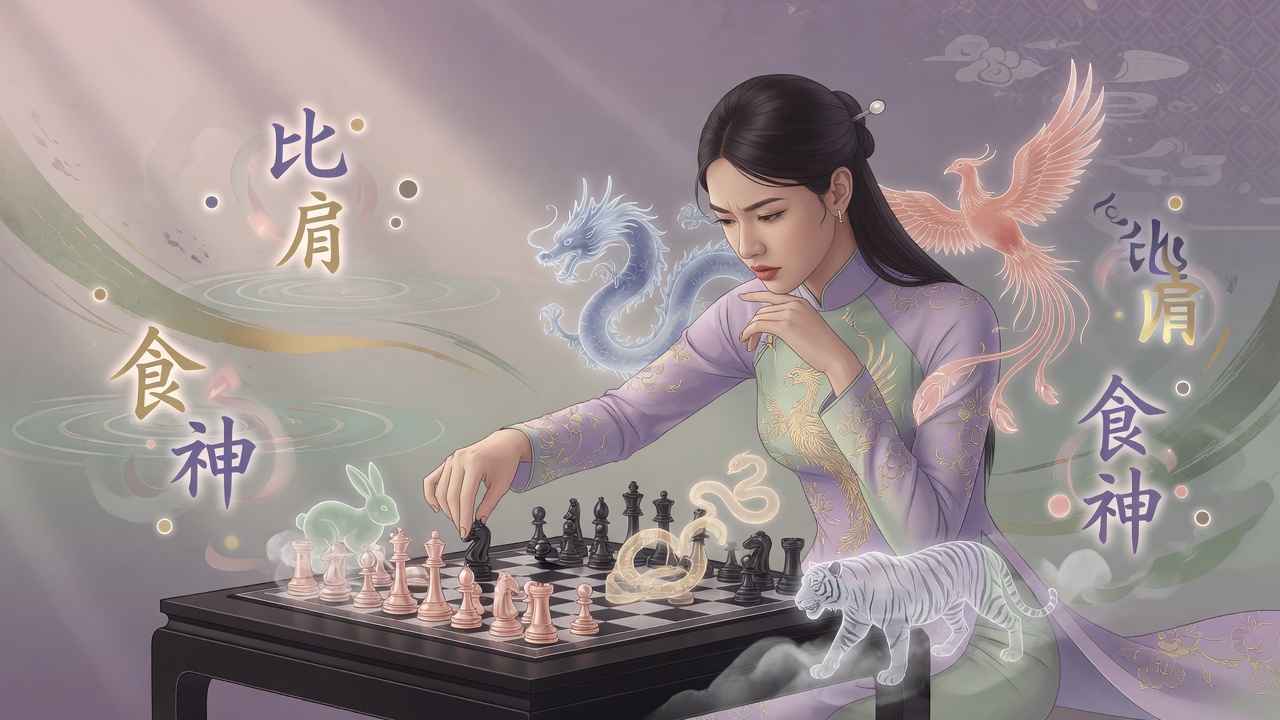
Basic Clarification: Ba Zi Is Not a Verdict of Destiny
Common Misunderstandings
- Myth 1: Ba Zi can predict the outcome of every single match. Ba Zi reveals character tendencies and energy cycles, not the results of specific events. People with the same Ba Zi can have completely different life paths.
- Myth 2: Strong Bi Jie always means aggressiveness, and strong Shi Shang always means intelligence. The Ten Gods are neutral energy labels. They must be interpreted by combining Day Master strength, structural configuration, and Luck Pillars and Annual Cycles. Judging any single god in isolation leads to bias.
- Myth 3: Ba Zi is superstition and has nothing to do with competitive sports. Traditional Ba Zi is essentially the ancients’ summary of personality classification and timing patterns, sharing similarities with modern psychology and athletic state management.
Core Points: How Bi Jie and Shi Shang Shape Competitive Character
Bi Jie: The Source of “Fighting Spirit” in the Arena
In Ba Zi, the stems and branches that share the same Five Element as the Day Master are called Bi Jian (same yin-yang) and Jie Cai (opposite yin-yang), collectively known as Bi Jie. They represent self-awareness, competitive drive, and stress resilience.
During long chess matches, a player needs intense mental focus and an unyielding tenacity — this is the positive manifestation of strong Bi Jie. Bi Jie acts as an inner “comrade,” granting the determination to persevere.
- Bi Jian: Symbolizes independence, self-esteem, and steadiness. A player with strong Bi Jian often advances cautiously, defends tightly, and avoids unnecessary risks.
- Jie Cai: Symbolizes assertiveness, decisiveness, and action. A player with prominent Jie Cai excels at fierce attacks and dares to initiate battles in complex positions.
- Excessive Bi Jie without restraint: May turn into stubbornness and impulsiveness, leading to overconfidence and rash moves when ahead, causing mistakes. Therefore, Ba Zi emphasizes proper “control and transformation.”
Shi Shang: The Root of “Clever Strategy” on the Board
The elements produced by the Day Master with the same yin-yang are Shi Shen, and those with opposite yin-yang are Shang Guan, collectively called Shi Shang. They represent the output of wisdom, creativity, and strategic expression.
Chess is a battle of wits. Opening setups, traps, sacrifices for initiative — all require flexible thinking and precise calculation, which is exactly the domain where Shi Shang functions. Shi Shang serves as the player’s “strategist,” continuously supplying brilliant moves.
- Shi Shen: Symbolizes gentle wisdom and meticulous calculation. A player with strong Shi Shen often plans deeply, excels at controlling the game, and overcomes strength with softness.
- Shang Guan: Symbolizes unconventional, rule-breaking talent. A player with well-utilized Shang Guan often makes genius, unexpected moves that suddenly reverse the situation.
- Excessive Shi Shang draining a weak Day Master: May lead to overthinking and being overly ambitious but lacking execution. The calculation may be precise, but decisiveness is missing, letting opportunities slip. Therefore, Shi Shang needs the support of Bi Jie or the restraint of Yin Star.
The Interplay of Bi Jie and Shi Shang: Ba Zi Timing for Competitive Peak
In Ba Zi, Bi Jie can generate Shi Shang. When a Luck Pillar or Annual Cycle activates the Bi Jie in the natal chart and subsequently strengthens Shi Shang, it is often a period when a person’s mind is most active and their fighting spirit most intense.
For a chess player, this interplay means that “fighting will” and “strategic intelligence” are online simultaneously: both the determination to win and the clever plans to defeat the opponent. Many players achieve great results in years when such combinations appear in their charts.
However, it must be emphasized that this is not a formula for predicting victory. Competitive outcomes are also influenced by the opponent’s condition, environment, psychology, and other complex factors. Ba Zi only reveals the ebb and flow of personal energy, not a substitute for real effort.
- Bi Jie annual cycle: Helps strengthen stress resistance, suitable for participating in high-intensity tournaments, but one must be careful to avoid recklessness from overconfidence.
- Shi Shang annual cycle: Thoughts open up, making it easy to produce innovative games, but one must guard against time pressure caused by overly deep calculations.
- Bi Jie generating Shi Shang annual combination: Represents a peak period of competitive form, with both tenacious defense and sharp offense, often allowing an extraordinary performance.
Avoidance Guide: Three Iron Rules for Using Ba Zi to View Competitions
Important Notes
- Never judge by a single pillar or single god. Ba Zi is the holistic coordination of eight characters. Looking only at Bi Jie or Shi Shang in isolation is like looking at just one piece on the chessboard — it cannot grasp the full picture. One must combine Day Master strength, favorable/unfavorable elements, Ten God combinations, and Luck Pillar trends for a comprehensive analysis.
- Do not use it for gambling or predicting exact rankings. Ba Zi reveals trends and traits, not precise scores or rankings. Anyone claiming to use Ba Zi to calculate exact competition placements is practicing pseudo-Ba Zi.
- Competitive results are influenced by multiple factors. The opponent’s chart, on-site environment, physical condition, and even referee factors can sway victory or defeat. Ba Zi is only a tool for self-understanding, not an all-purpose oracle.
- Respect privacy and do not fabricate birth data. In public discussions, it is strictly forbidden to create fictional Ba Zi charts for celebrities or athletes to conduct so-called “Ba Zi analysis.” This is a double disrespect to both traditional culture and personal privacy.
Summary and Recap
The outstanding achievement of the Vietnamese female chess player shows us that the competitive spirit and strategic intelligence required in strategic competition correspond exactly to Bi Jie and Shi Shang in Ba Zi. Bi Jie endows a person with resilient tenacity, while Shi Shang grants the inspiration to break through deadlocks. Understanding these Ba Zi traits is not for predicting victory or defeat, but for better self-understanding, so that in the chess game of life you can seize your own “peak moments.”
Ba Zi is a map of character and timing left by the ancients. Viewing it with a rational eye can bring you an extra measure of composure in competition and in life.