Studying Abroad: Understanding Personality, Choices, and Timing Through Bazi Culture
A recent incident involving a Chinese international student in South Korea has brought overseas safety and psychological adaptation back into focus. This article explores how Bazi culture provides a framework for understanding personality, relationsh
Introduction
Recently, an incident in Gyeongsan, South Korea involving a Chinese international student has made overseas safety and psychological adaptation hot topics.
Studying abroad is full of uncertainties and challenges. How to settle your mind and make choices in an unfamiliar environment is a lesson every international student faces.
As part of traditional Chinese destiny studies, Bazi culture offers a framework for observing personality traits and shifts in timing, helping us understand ourselves more rationally.
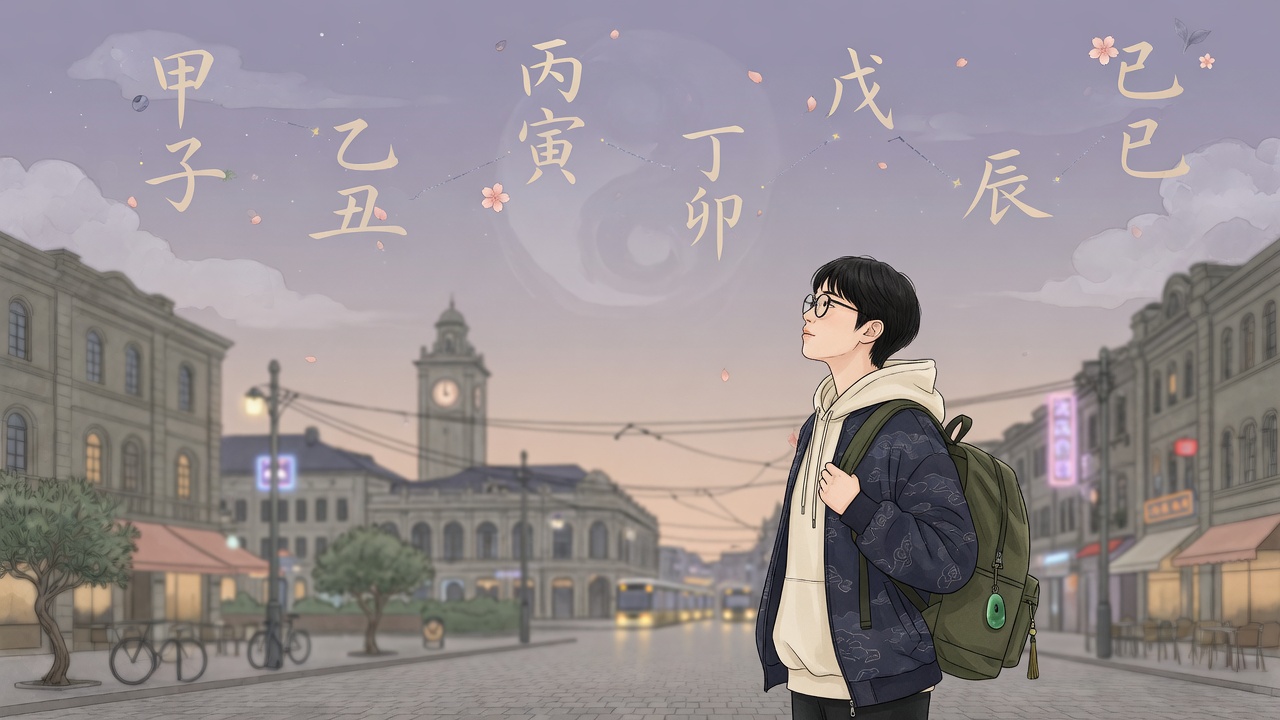
Basic Clarifications
Common Misconceptions
Bazi is not a mystical fatalism; it is more like an ancient personality analysis tool that describes tendencies and possibilities, not inevitable outcomes.
- Misconception 1: Bazi can precisely predict specific events or crimes. In reality, it only reflects trends and traits, not specific actions.
- Misconception 2: International students have a special destiny pattern. Actually, everyone can see their adaptation mode through Bazi, with no inherent superiority or inferiority.
- Misconception 3: Reading Bazi is about changing luck and avoiding disaster. A rational approach is to understand your own characteristics to optimize daily choices, rather than relying on external forces.
Core Insights
Bazi Personality Base and Study Abroad Adaptability
Bazi centers on the Day Master (the Heavenly Stem of the birth day), representing a person's fundamental energy state. The strength of the Day Master and the distribution of the Five Elements shape different adaptation styles.
Those with a strong Day Master usually have ample drive and better stress resistance, but may overlook details due to overconfidence; those with a weak Day Master are sensitive and observant, yet prone to self-doubt under pressure.
The Five Elements also influence adaptation strategies: Wood governs growth and benevolence, tending to integrate into new environments; Fire governs passion and expression, enjoying socializing but needing to manage emotional drain; Earth governs stability and grounding, adapting slowly but with a solid foundation; Metal governs righteousness and decisiveness, valuing principles but possibly lacking flexibility; Water governs wisdom and fluidity, being flexible and adaptable but needing to avoid drifting aimlessly.
For example, an international student with strong Fire and Earth may quickly find their place in a group but easily become exhausted from too many activities; one with Metal and Water mutually generating tends to think independently, make friends cautiously, and need more personal space.
- Day Master Strength: Influences your initial reaction to unfamiliar environments—whether you proactively engage or observe before acting.
- Five Element Bias: Indicates in which areas you easily leverage strengths and which situations might bring pressure.
- Useful God: The key element balancing the entire chart, corresponding to the support resources you most need during difficult times.
Interpersonal Relationships and Academic Choices Through the Ten Gods Lens
The Ten Gods are symbols in Bazi describing interaction patterns with the external world, including Companion, Rob Wealth, Eating God, Hurting Officer, Direct Wealth, Indirect Wealth, Direct Officer, Seven Killings, Direct Resource, and Indirect Resource.
In a study abroad context, Companion represents classmates and peers; many Companions value friends but easily fall into competition. Rob Wealth hints at potential conflicts of interest in cooperation, requiring attention to boundaries.
Eating God and Hurting Officer relate to expression and creativity: Eating God is gentle, beneficial for arts and cultural studies; Hurting Officer is sharp, suitable for critical majors, but needs careful wording.
Direct Officer and Seven Killings symbolize rules and pressure: those with strong Direct Officer adapt to systems and respect authority; those with strong Seven Killings handle high-pressure environments better but are easily tense.
Direct Resource and Indirect Resource represent learning and protection: those with Direct Resource as Useful God need stable mentor support, while Indirect Resource tends toward independent research.
Understanding your Ten Gods combination helps you comprehend your role in a team and potential patterns when facing advisors, roommates, and competition.
- Excessive Companion/Rob Wealth: Reminds you to avoid excessive self-focus in group projects and learn cooperation and sharing.
- Eating God/Hurting Officer Revealed: Suitable for relieving stress through writing, art, and expression, rather than suppressing emotions.
- Mixed Direct Officer and Seven Killings: May face dual pressure from academics and external rules simultaneously, requiring clear time management.
- Resource Stars as Useful God: Actively finding good mentors and friends to build a learning support network is especially important.
Luck Pillars and Annual Cycles: Aligning Timing with Personal Rhythm
The natal Bazi chart is like a map, while Luck Pillars (changing every ten years) and Annual Cycles (changing yearly) depict the climate of different stages, influencing our energy distribution and opportunity windows.
Study abroad life often spans multiple annual cycles, possibly experiencing Resource Star years favorable for exams and advanced studies, Wealth Star years focusing on part-time jobs and material matters, Officer Star years facing regulatory pressure, and Eating God/Hurting Officer years stimulating creativity and expression.
Timing is not an irresistible fate but a reminder to adjust strategies in different years: for instance, in a year with strong Companion/Rob Wealth, pay attention to interpersonal relationships; in a year with strong Resource Star, reading and seeking advice more often will likely yield gains.
A rational view of Luck Pillars and Annual Cycles treats them as a time-dimension reference, not passively waiting for predictions to come true. You can choose to plan ahead or adjust your mindset.
- Luck Pillar Transition: May accompany a shift in life focus, such as from study to employment; understanding it in advance helps smooth the transition.
- Annual Cycle Clashes: For example, a year clashing with the Day Pillar easily brings environmental changes or inner unrest, suitable for proactively seeking stability rather than taking risks.
- Useful God Annual Cycle: Often yields twice the result with half the effort; seize opportunities to advance important goals.
- Unfavorable God Annual Cycle: Best to be conservative and introspective, avoid major decisions, and focus on accumulation.
Pitfall Avoidance Guide
Key Precautions
- Do not self-label: Bazi traits are only tendencies, not your 'destiny'; avoid using destiny studies to limit your possibilities.
- Do not simplistically attribute hot-button events to Bazi: International student safety and psychological issues involve multiple social, cultural, and personal factors; focus on real-world support systems.
- Beware of online destiny scams: Paid luck changes, expensive consecrations, and master enlightenments are mostly frauds; maintain rational consumption.
- Use Bazi as a self-exploration tool: Combine it with modern psychology and career planning, not as a replacement for professional psychological counseling or medical help.
- Prioritize formal channels when facing difficulties: University international student offices, psychological counseling centers, and consulates are more reliable than destiny predictions.
- Respect privacy in communication: Do not casually request or spread others' birth information to avoid causing distress.
- Understand the cultural temporality: Bazi was formed in ancient agricultural society; applying it to modern study abroad contexts requires transformation and selective adaptation, not rigid copying.
Summary and Reflection
Bazi culture offers international students a mirror, reflecting personality base and timing rhythm, but the mirror does not walk the path for you.
The true key conclusion is: knowing yourself is for making clearer choices; respecting timing is for acting with more composure, not waiting for fate to arrange everything.