Bazi Insights After the Storm: How Bijie and Yinxing Reflect the Human Warmth of Community Resilience
In August 2026, a storm battered Hong Kong, severely damaging homes—but neighbors swiftly rallied to help with repairs, bringing community mutual aid back into focus. In Bazi astrology, such peer support corresponds to the **Bijie (Friends and Pa
Introduction
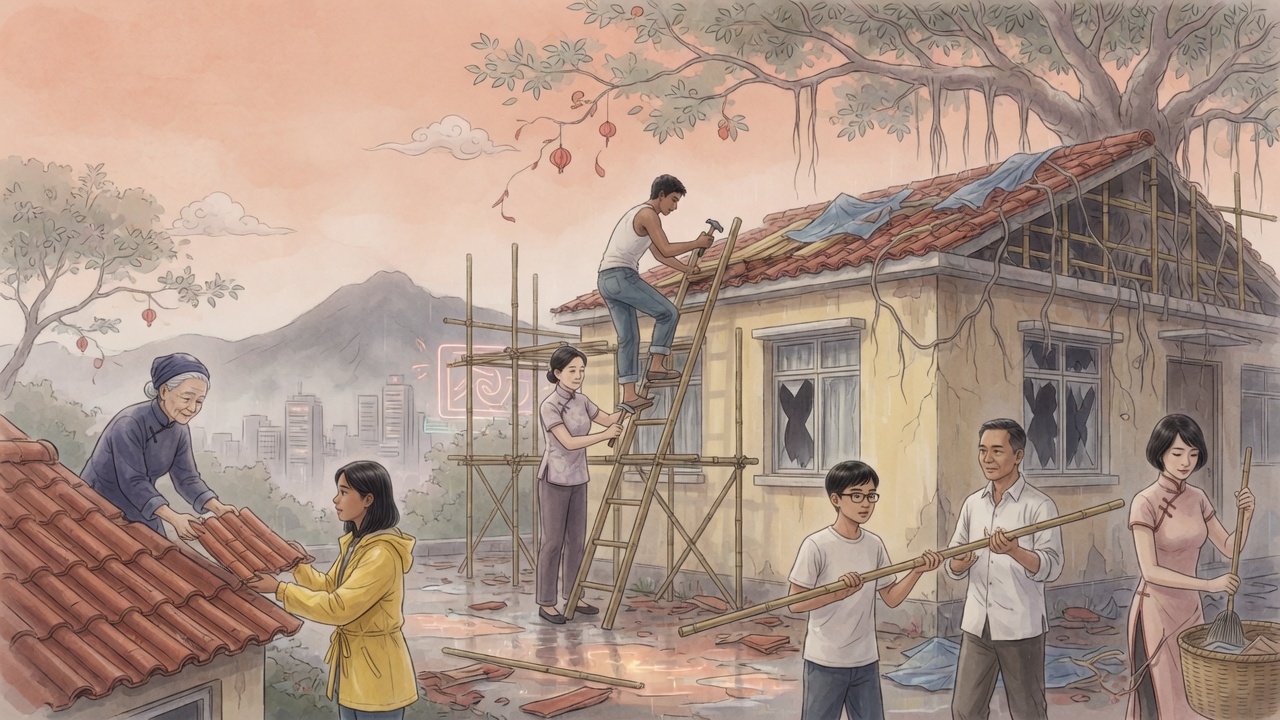
A sudden August storm swept through Hong Kong, tearing off roofs but also unleashing a wave of neighborly solidarity. The community spontaneously gathered to clear debris and rebuild homes for affected residents.
In the Bazi framework, such shoulder-to-shoulder action among peers is a vivid projection of Bijie; meanwhile, external supplies, guidance, and protection resonate with the energy of Yinxing.
Starting from this heartwarming news, we strip away the superstitious veneer to explore how astrological symbols interpret collective mutual aid and individual choices in the wake of disaster.
Basic Clarification: Bijie Isn't Just Competition; Yinxing Isn't Just a Diploma
Common Misconceptions
When first learning Bazi, many people easily simplify Bijie as mere rivalry or financial loss, and narrow Yinxing down to academic qualifications. This obscures their positive meanings in interpersonal and social contexts.
- Misconception 1: Bijie equals backstabbing wealth loss. In reality, Bijian (Friend) represents same-sex peers, siblings, and partners; Jiecai (Parallel) represents opposite-sex peers and highly action-oriented collaborators. When a chart needs support, Bijie acts as a deeply needed allied force.
- Misconception 2: Yinxing is only about academic luck. Zhengyin (Direct Seal) symbolizes a mother, elder, protector, and stable backing; Pianxing (Indirect Seal) relates to unconventional wisdom, technical support, and spiritual transformation. Yinxing is a protective umbrella in adversity, far more than a diploma.
- Misconception 3: Astrology only sees individual fate. Although a Bazi chart centers on the Day Master, its network of Ten Gods essentially describes the energy exchange between a person, the outside world, and others. Community mutual aid after a disaster is a collective manifestation of Bijie and Yinxing stepping from the chart into reality.
Core Points: Deconstructing the Inner Logic of Community Mutual Aid Through Bazi's Ten Gods
Bijie: The Restorative Power of Peers Working Side-by-Side
In a Bazi chart, elements sharing the same Five Element as the Day Master are Bijie. Bijian is like a parallel comrade; Jiecai is like a passionate fellow traveler. When a chart is weak, Bijie is the most direct channel for reinforcement.
After the Hong Kong storm, neighbors didn't wait for government mobilization; they spontaneously arrived with tools. This horizontal bonding and voluntary burden-sharing perfectly mirrors the united effort of Bijie—acting without calculative motives, simply because they share a common situation.
From an astrological perspective, people with strong Bijie inherently possess group consciousness and easily step forward in crises. The community mutual aid scene also proves the positive release of Bijie energy in reality.
- Bijian Characteristics: Stable, persistent, quietly contributing. Like the old neighbor who helped clear rubble for three consecutive days, unassuming but indispensable.
- Jiecai Characteristics: Decisive, quick to act, daring to break through. Like the young person who first climbed onto the roof to cover it with tarpaulin, inspiring everyone with courage.
- Weak Day Master encountering Bijie: When the Day Master is inherently weak in the chart, Bijie is the favorable, helpful god. Encountering it brings peer support and team backup. An isolated resident after the storm turning safe due to community intervention exemplifies this principle.
- Warning for overly strong Bijie: If Bijie is excessively strong and unchecked in a chart, it can devolve into diffused responsibility or emotional contagion. Community aid requires orderly organization to avoid chaotic, inefficient crowding.
Yinxing: The Vertical Delivery of Shelter and Resources
Yinxing is the element that nurtures the Day Master. Zhengyin is like a loving mother's embrace, providing material security and emotional comfort; Pianxing is like a teacher's guidance, offering technical solutions and alternative perspectives.
In the news, a community center opened temporary shelter, social workers coordinated supplies, and engineers voluntarily assessed structural safety. This support from organizations, elders, and professionals is the externalization of Yinxing energy.
Yinxing plays a dual role in post-disaster rebuilding: on one hand, acting as a safety net to catch vulnerable individuals; on the other, being a source of wisdom to guide restoration. Astrology is not fatalism, but a symbolic revelation of the deeper value of social support systems.
- Zhengyin's Inclusiveness: Symbolizes unconditional acceptance. The community canteen providing hot meals to affected families is like Zhengyin's nourishment, helping recipients regain physical and mental stability.
- Pianxing's Ingenuity: Symbolizes unconventional solutions. A retired carpenter teaching quick reinforcement techniques is precisely the practical wisdom associated with Pianxing.
- When Yinxing is the Favorable God: People with a weak Day Master but strong Yinxing in their chart easily find benefactor protection in hardship. Those who proactively seek social welfare resources after a disaster often have Yinxing playing a positive role in their astrological makeup.
- Reflection on overly strong Yinxing: Over-reliance on Yinxing leads to passive waiting. In community mutual aid, if recipients only accept help without participating, it deviates from the positive cycle of Bijie co-creation.
The Synergy of Bijie and Yinxing: Dual-Track Rescue from Chart to Community
A single Ten God can't support the whole picture. Bazi emphasizes generation and control cycles. The interplay of Bijie and Yinxing is just like the interweaving of horizontal companionship and vertical support in community mutual aid.
Take the post-disaster scenario: neighbors contribute labor (Bijie), and professionals contribute strategies (Yinxing). Only by combining both can efficient restoration happen. When Bijie and Yinxing generate each other or are favorable in a chart, it often corresponds to a reality where both popularity and benefactors coexist.
From a rational perspective, astrology merely uses symbolic language to structure the collaborative instincts of human society. The community's self-organization after the storm is a seamless connection of Bijie's collective strength and Yinxing's shelter in reality.
- Bijie generates Shishang, Yinxing controls Shishang: If neighbors' practical efforts (Bijie generating Shishang, meaning output and action) lack planning, Yinxing's coordination can restrain chaos and boost efficiency.
- The Bijie-Yinxing Alliance under Guan Sha pressure: The storm as sudden pressure (analogous to Guan Sha, or Authority/Seven Killings) triggers Bijie's resistance and Yinxing's resolution. A community collectively coping with disaster is a group-level manifestation of 'controlling the Sha.'
- Astrological Insight: Regardless of one's personal chart, actively integrating into a mutual aid network is equivalent to consciously deploying the positive energies of Bijie and Yinxing in real life. This isn't about changing destiny, but strategically leveraging circumstances and collective force.
Avoidance Guide: Astrological Reflections on Post-Disaster Mutual Aid
Important Notes
- Reminder 1: Do not equate Bijie with blind groupthink. Mutual aid requires clear division of labor to prevent diluted responsibility. In Bazi, unchecked Bijie leads to competing for credit and shirking blame. Community actions should appoint coordinators to turn enthusiasm into effective output.
- Reminder 2: Yinxing shelter avoids excessive intervention. Though Zhengyin is good, too much fosters dependency. Aid should progressively empower, allowing affected individuals to participate in repair decisions, preventing the solidification of a 'helped victim' mindset.
- Reminder 3: Respect individual astrological differences. Some are naturally strong in Bijie and charge ahead; others are heavy in Yinxing and coordinate behind the scenes. A community should accommodate different roles without forcing uniformity. This aligns with the personalized logic of Bazi's favorable and unfavorable gods.
- Reminder 4: Post-disaster emotional counseling is indispensable. After Guan Sha-type pressure, Shishang (expression, venting) must be allowed. Organizing sharing sessions and setting up outlets for talking is a collective application of the Bazi principle 'Shishang releases one's elegance.'
- Reminder 5: Long-term rebuilding relies on Caixing (Wealth Star) balance. Bijie and Yinxing resolve the initial crisis, but subsequent resource distribution and fundraising require introducing Caixing thinking—transparency, circulation, and fair exchange—to avoid unilaterally draining neighborly goodwill.
- Reminder 6: Do not judge others with astrological labels. Bazi is an analytical tool, not a moral yardstick. In a community, some give quietly (Bijian), some organize energetically (Jiecai)—each has value. Understanding differences is key to coalescing strength.
Summary and Review
The community restoration after the Hong Kong storm is a vivid reflection of Bijie's peer collaboration and Yinxing's sheltering wisdom in reality. Bazi astrology is not abstract mysticism but an ancient language for deconstructing interpersonal support systems through the Ten Gods.
The core revelation is this: in times of trouble, horizontal camaraderie and vertical resource protection are both indispensable. Understanding this astrological logic isn't about teaching fortune-telling, but reminding us that the instinct for mutual aid is already engraved in our cultural genes—we just need to consciously tap into it when times demand.