The Basic Method of Plum Blossom Divination: From Numbers to Symbols, the Mysterious Gate
Plum Blossom Divination is flexible and free in casting hexagrams, relying only on the three essentials: number, symbol, and principle. With just a number, a thought, or a sound, you can derive the Eight Trigrams, then apply *host and guest
Introduction
The core of Plum Blossom Divination lies in numbers. All things possess numbers, numbers generate hexagram symbols, and symbols conceal fortune and misfortune.
It does not require fifty yarrow stalks or the tossing of coins; instead, it seizes the moment, taking numbers spontaneously to form a hexagram instantly.
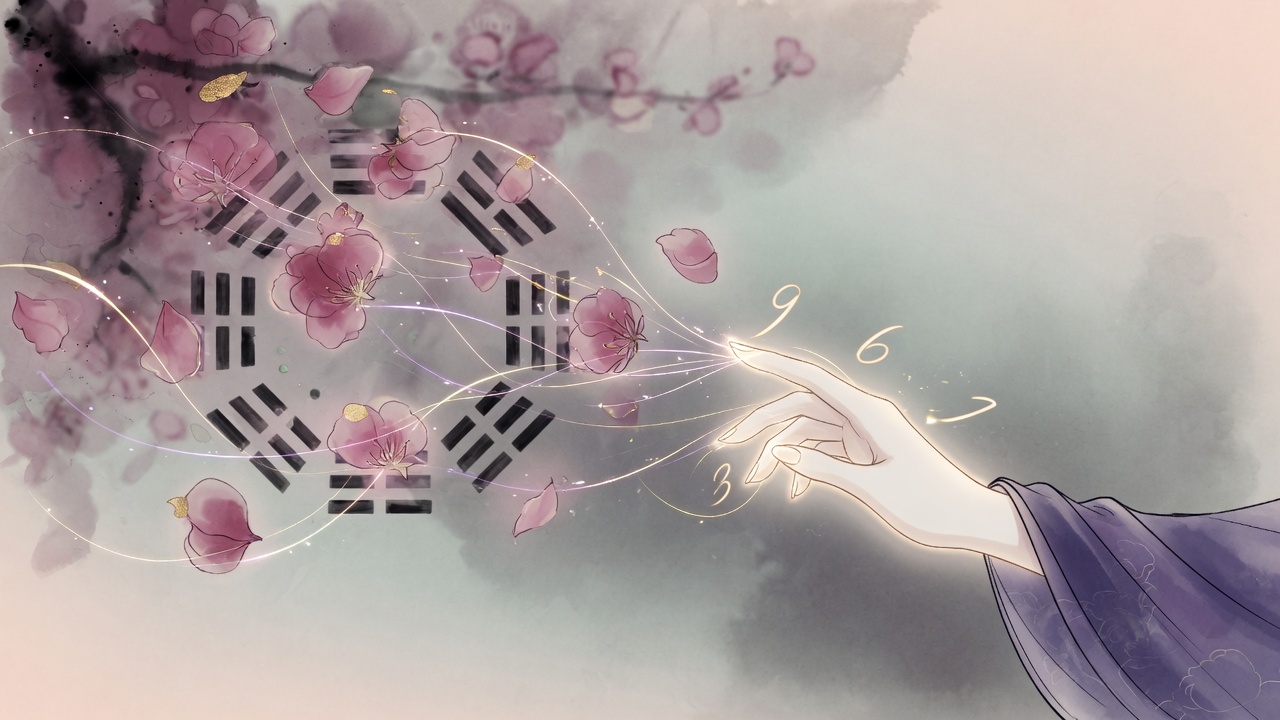
Clarification: Not Mysticism, but Symbol-Number Logic
Common Misconceptions
- Misconception 1: Plum Blossom Divination must use three copper coins. In fact, it originated from Shao Yong's simplification of the I Ching, centered on pre-heaven numbers rather than specific tools. Numbers, sounds, and time can all be used for casting.
- Misconception 2: The more complicated the casting, the more accurate it is. Plum Blossom emphasizes simplicity; a sincere thought and a casually taken number are most effective. Deliberate design leads to distortion.
- Misconception 3: After casting, rely only on hexagram texts. Plum Blossom forms its own system, emphasizing host-guest interaction and the classification of all things; hexagram texts are only for reference.
Core Points: The Three Steps of Hexagram Casting and the Heart Method of Host and Guest
Step 1: Obtaining Numbers – All Things Can Be Numbers
To cast a hexagram, first obtain numbers, which correspond to the three powers: upper hexagram number, lower hexagram number, and moving line number. Methods for obtaining numbers are endlessly varied, but must adhere to the present moment and thought.
Common ways to obtain numbers: use year, month, day, and hour to derive numbers, for example, Hai year 12, third month 3, twenty-fourth day 24; or derive from object counts, such as seeing three people walking and using 3; even a number suddenly appearing in thought, like house number 27.
The key is naturalness, avoid forcing. Hearing three bell tolls, use 3; glimpsing five flying birds, use 5. This is seizing the moment.
- Time-based numbers: Use the Earthly Branch number of the year, lunar month, day, and hour numbers; sum them to find the moving line. For example, Wu year 7, month 7, day 15: upper hexagram 5 (Wu belongs to Li), lower hexagram 15 ÷ 8 remainder 7 (Gen), moving line 7+15=22 ÷ 6 remainder 4.
- Object-based numbers: Directly assign hexagrams according to the classification of all things. For example, seeing a Dui object (like a cup) corresponds to Dui hexagram; seeing fire corresponds to Li, directly used as upper or lower hexagram.
- Number-based: Any three numbers, e.g., 789. First number 7 ÷ 8 remainder 7 is Gen (upper), second number 8 ÷ 8 remainder 0 is Kun (lower), third number 9 ÷ 6 remainder 3 is the moving line. If numbers are insufficient, supplement or split them.
Step 2: Forming the Hexagram – Transforming Numbers into Hexagram Symbols
After obtaining numbers, follow the pre-heaven trigram numbers: Qian 1, Dui 2, Li 3, Zhen 4, Xun 5, Kan 6, Gen 7, Kun 8. If a number exceeds 8, divide by 8 and take the remainder; if divisible, assign Kun 8.
The upper hexagram is determined by the first number, the lower by the second. After the original hexagram is formed, find the moving line: sum of the three numbers (or directly use the third number) divided by 6, and the remainder is the moving line (counted from the first line). The hexagram containing the moving line is the guest hexagram, the static one is the host hexagram.
By changing the yin-yang nature of the moving line in the original hexagram, the transformed hexagram is born. The mutual hexagram is taken from lines 2-3-4 of the original hexagram as the lower mutual, and lines 3-4-5 as the upper mutual, reflecting the process and intermediate states.
- Original Hexagram: The upper and lower trigrams stacked into six lines, showing the current situation.
- Mutual Hexagram: Derived from the middle lines, revealing hidden factors in development.
- Transformed Hexagram: The hexagram after the moving line changes, indicating the outcome.
- Host-Guest Interaction: Host represents the self, guest the matter. Host-guest harmony is auspicious; guest producing host is auspicious; host producing guest depletes; guest overcoming host is ominous. Also consider hexagram qi strength and weakness.
Step 3: Interpreting the Hexagram – Linking Host-Guest Dynamics and Symbol Classification
Plum Blossom interpretation does not rigidly follow line texts; first examine host-guest interaction. The host hexagram represents the querent, the main party, the core matter; the guest hexagram represents the matter asked, the other party, the environment.
The generating-overcoming relationship sets the basic tone of fortune, then integrate trigram classification for detailed reading. For example, if host is Li Fire and guest is Kan Water, guest overcomes host, indicating obstacles; Li Fire represents documents, middle daughter; Kan Water represents theft, pitfalls – one may deduce documents lost due to theft.
Observe the mutual hexagram to gauge intermediate changes; examine the transformed hexagram to understand the final direction. At the same time, incorporate time, direction, and external omens – all things can become symbols.
- Harmony: Host and guest same trigram or balanced interaction, indicating smoothness.
- Guest produces host: External help, half the effort, double the result.
- Host produces guest: More giving than receiving, depleting self for others.
- Host overcomes guest: The matter can be accomplished but requires effort.
- Guest overcomes host: Great misfortune, need for caution.
- Case: Asking about cooperation, obtaining Lei Huo Feng changing to Zhen Wei Lei, fourth line moving. Host hexagram Li Fire, guest hexagram Zhen Wood, wood produces fire, very auspicious. Mutual hexagrams Xun, Li, Dui appear, indicating smooth documentation and contracts; transformed hexagram harmony, lasting cooperation.
Pitfall Avoidance: Five Most Common Mistakes in Hexagram Casting
These details are often overlooked
- Remainder after dividing by 8: Always divide by 8 and use the remainder to determine the trigram; divide by 6 for the moving line. Many beginners directly use the number as the trigram, but numbers above 8 cannot correspond.
- Do not reverse the order of numbers: First number is upper, second is lower, third is moving. If the order is wrong, host and guest are reversed, leading to completely opposite conclusions.
- Do not confuse host and guest: The moving line is only in the guest hexagram; the host hexagram never moves. If both upper and lower trigrams contain moving lines (rare), determine the guest based on the moving line's position, or use external omens to distinguish primary and secondary.
- Do not obsess over clever methods: Casting hexagrams values sincerity and resonance; deliberately pursuing exotic number methods deviates from the natural way. Beginners should first practice with time-based casting.
- Avoid repeated casting: Repeatedly casting on the same matter is disrespectful to divination; the more you ask, the less accurate it becomes. When in doubt, calm your mind, hold one thought, and cast only one hexagram.
Summary and Review
Plum Blossom Divination is simply numbers manifesting as symbols, symbols judged by principles. Take numbers spontaneously, derive hexagrams from them, discern host-guest interactions, and observe mutual and transformed relationships.
Knowing how to cast is just the beginning; the skill of interpretation lies beyond the hexagram – one must memorize trigram classifications and accumulate experience with external omens. Remember, the most accurate hexagram is always born from the truest thought of the present moment.