From the “Tae Dragon Five” Case: Character, Choices, and Timing in Ba Zi
Recently, the disappearance of Thai public figure “Tae Dragon Five” after cycling from Bang Kruai has drawn widespread attention, and the event itself is full of suspense. This article does not discuss personal destiny or make any assertions about fo
Opening Guide
A few days ago, prominent Thai figure “Tae Dragon Five” went missing after cycling out from the Bang Kruai area, quickly becoming a hot topic online. The incident tugs at heartstrings and has sparked much speculation.
We have no intention of guessing the specific reasons, but we can use this opportunity to explore the relationship between human nature, decision-making, and external circumstances through the lens of Ba Zi (Eight Characters) fate analysis. Ba Zi is not a tool for deterministic fate-telling, but an ancient instrument for understanding personal traits and changing timings.
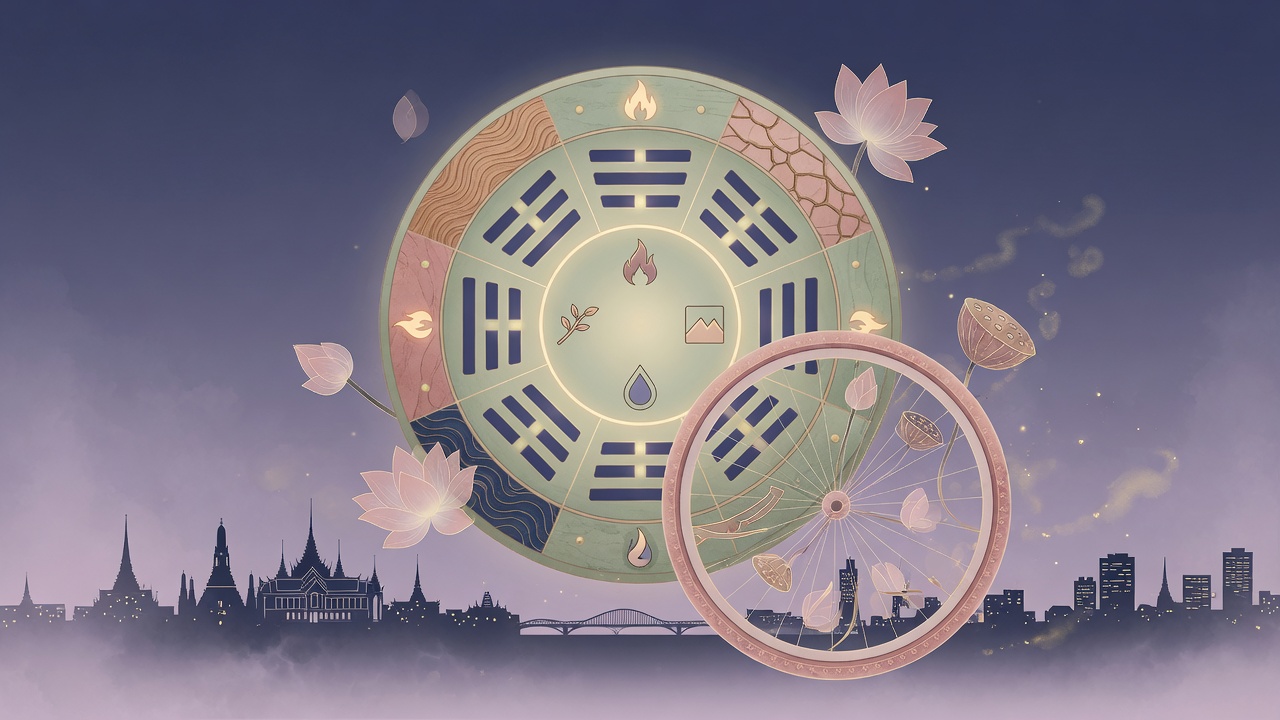
Basic Clarification: What Can Ba Zi Tell Us?
Common Misunderstandings and Correct Views
- Myth 1: Ba Zi can calculate a person's detailed life destiny, including when they will disappear or what will happen to them. In reality, Ba Zi analyzes innate tendencies and character foundations, not a script of specific events.
- Myth 2: One's birth date determines an inevitable outcome, and human effort cannot change it. The essence of Ba Zi lies in “knowing your fate and using it”—understanding your strengths and limitations to make better choices.
- Myth 3: Only “masters” can read Ba Zi, and ordinary people cannot get started. While Ba Zi does have professional barriers, its core principles—such as the Five Elements' generating and overcoming cycles and Ten Gods relationships—can be understood through education.
The Core Value of the Ba Zi System
It is like a personality map, arranged from the Heavenly Stems and Earthly Branches of the year, month, day, and hour of birth, analyzing the relationship between the Day Master (representing oneself) and other stems and branches, helping to recognize character inclinations, latent strengths and weaknesses, and energy fluctuations in different life stages.
In traditional culture, it is used for self-cultivation, career planning, and interpersonal interaction, not as a deterministic tool. Times create heroes, but heroes also change the times through their choices.
Core Points: Character, Choices, and Timing Through Ba Zi
1. The Character Code: Your Day Master and Ten Gods
In Ba Zi, the Day Stem is called the “Day Master,” representing the person themselves. Different Day Masters correspond to different Five Element attributes; for example, a Jia Wood person tends to be responsible, while a Bing Fire person is passionate and outgoing. This is the broadest character tone.
A more refined analysis looks at the Ten Gods, which are the generating and overcoming relationships of other stems and branches around the Day Master: Direct Officer, Seven Killings, Direct Resource, Indirect Resource, Eating God, Hurting Officer, Friend, Rob Wealth, Direct Wealth, Indirect Wealth. Each Ten God reflects a type of psychological trait.
- Strong Direct Officer: disciplined, rule-abiding, but may be overly conservative. Strong Seven Killings: decisive, pioneering, but prone to impulsiveness.
- Eating God producing wealth: good at creativity and expression, willing to give. Hurting Officer exposed: intelligent and rebellious, likes to break norms.
- Direct Resource protecting the body: values knowledge security, prefers stability. Strong Indirect Resource: often has unique thinking, dislikes following the crowd.
- These traits are not absolutely good or bad; the key is whether you can know yourself and play to your strengths and avoid weaknesses in different situations.
2. Timing and Choices: How Luck Cycles and Annual Influences Affect Us
Ba Zi emphasizes the interaction between the natal chart and the Luck Cycle (Da Yun) and Annual Cycle (Liu Nian). The natal chart is like a car, the luck cycle is like the road, and the annual cycle is like the weather. The same car performs very differently under different road and weather conditions.
The Luck Cycle changes every ten years, derived from the month pillar in forward or reverse order, activating different Five Element energies. For example, a Day Master of weak Wood, when entering a Water-Wood luck cycle, will feel energetic and encounter more opportunities; if encountering a strong Metal cycle, they may feel suppressed and need to keep a low profile.
- Go with the flow: When the luck cycle is your favorable element, take initiative, make bold decisions, and you'll often achieve twice the result with half the effort.
- Retreat and consolidate: When the luck cycle is your unfavorable element, it's not wise to expand blindly; it's better to study, rest, and accumulate strength.
- Annual triggers: Special years, such as those forming Heavenly Clash and Earthly Clash with the natal chart, can easily bring major changes, but the outcome depends on your original chart structure and your attitude in response.
- This reminds us: even when the external environment is unfavorable, you can choose to advance by retreating and avoid head-on collisions.
3. Real-World Projection of the Five Elements' Generating and Overcoming: Conflict and Transformation
The generating and overcoming cycles of the Five Elements are the foundation of Ba Zi analysis. Generating represents support and nourishment; overcoming represents restriction and shaping. In life, pressure, challenges, and accidents often manifest as “overcoming” forces in fate analysis.
But overcoming is not entirely negative. For example, Metal overcomes Wood to carve it into a tool; Water overcomes Fire to regulate temperature. The key is balance. If one element is too strong without control, it tends toward extremes. For instance, excessive Fire without Water leads to impatience and reckless actions.
- Water and Fire in harmony: Heart fire and kidney water intersect, representing the balance of reason and emotion. Those with Water-Fire balance in their Ba Zi often remain calm in crises.
- Wood and Fire bright and clear: Thought and action cooperate, often shining in arts and education. But too much Wood smothers Fire, leading to stubbornness.
- Earth and Metal mutual generation: Practicality combined with principles, suitable for finance and law. But thick Earth buries Metal, leading to excessive conservatism and missed opportunities.
- In real life, we should learn to observe our elemental imbalances and consciously compensate. For example, an impulsive Fire-type person can engage more with Water-type environments (such as meditation, swimming) to achieve balance.
Avoiding Pitfalls: Applying Ba Zi Wisdom Correctly
Precautions for Modern People in Viewing Ba Zi
- Do not use Ba Zi to determine life, death, or fortune: Ba Zi analyzes trends and probabilities, not a verdict. Any “absolute prediction” is irresponsible.
- Avoid over-reliance: Ba Zi can serve as a reference for decision-making, but cannot replace practical judgment. Always combine it with real-life situations and professional advice before acting.
- Beware of pseudo-masters: True fate analysis emphasizes logic and verification and will not demand huge sums for remedies. Anyone who scares you with “disaster in your fate” and then charges high fees to resolve it is likely a fraud.
- Do not become complacent because of a “good fate,” nor despair because of a “bad fate”: Fate theory emphasizes dynamic balance: first fate, second luck, third feng shui, fourth accumulating virtue, fifth studying—postnatal effort is crucial.
- View annual ups and downs rationally: Everyone experiences highs and lows; this is normal. Low periods are exactly the right time for introspection and learning.
- Ba Zi is not character determinism: Innate tendencies can be changed by postnatal environment, education, and experience. Don't label yourself as “born to be impulsive.”
Summary and Review
The disappearance of “Tae Dragon Five” is an unresolved social event, but the reflections it provokes can lead to beneficial education in traditional culture. The essence of Ba Zi is to help us know ourselves, understand changing timings, and make clearer choices in each moment. It does not claim predestination, but emphasizes proactive action under the correspondence between heaven and humanity.
Key conclusion: Character can be observed, timing can be discerned, but what ultimately determines the trajectory is still every small choice. May this ancient wisdom grant us insight, not shackles.