Air Conditioner Electricity Bill Exploding? Explore Your 'Heat-Tolerance Genes' and Spending Choices through Ba Zi
In the scorching summer of 2026, South Korea's 에어컨 (air conditioner) electricity bills became a heated topic—running the AC all day could result in a monthly bill of 290,000 won, and exceeding 450 kWh triggers a 'rate bomb. Facing the same he
Introduction
In August 2026, South Korea experienced a persistent heatwave, causing a surge in 에어컨 (air conditioner) usage and bringing suffocating electricity bills—running the AC all day pushed monthly costs past 290,000 won, and once electricity usage exceeded 450 kWh, the progressive pricing system turned into a 'rate bomb.' Social media was filled with laments, yet an intriguing phenomenon emerged: facing the same heat and high bills, some would rather sweat profusely than turn on the AC, while others unhesitatingly kept it on all day, even joking that 'life is more valuable than money.'
Such differences are certainly related to economic conditions and physiological tolerance, but within the centuries-old Ba Zi (Eight Characters) destiny analysis culture, we can find a unique explanatory framework. It does not predict electricity bill amounts or make decisions for people; instead, from the three dimensions of Day Master strength, Wealth Star configuration, and Luck Pillars and Annual Luck, it reveals the interaction tendencies between individuals and their environment, helping us become more aware of our own 'choice inertia.'
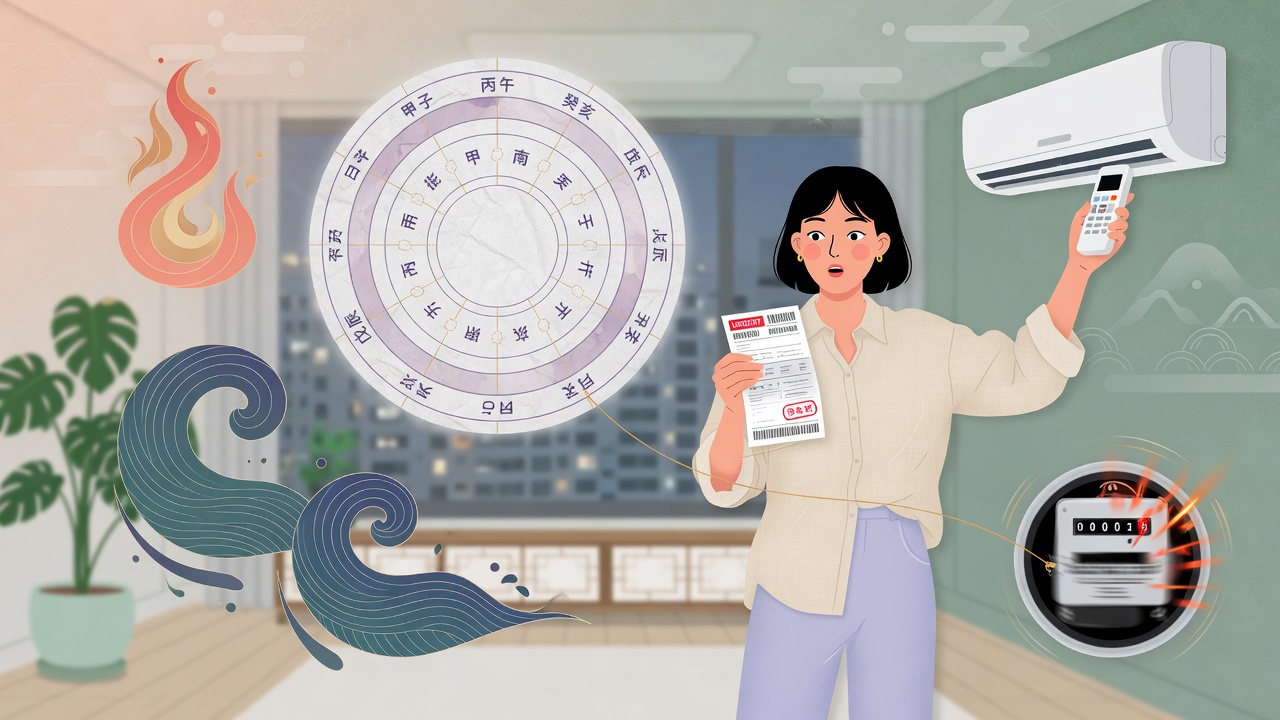
Basic Clarification: Destiny Analysis Is Not a Fatalistic Label
Common Misconceptions and Correct Understanding
Ba Zi destiny analysis originated in China and is often referred to as Saju (four pillars) in Korea, where it is still widely used as a reference for life planning. But many mistakenly believe that Ba Zi determines everything; in reality, it is more like a 'map of innate tendencies,' showing the basic patterns of interaction between you and your environment, rather than an unchangeable script. Especially when facing modern life choices like air conditioner electricity bills, we should view it rationally and avoid the following misconceptions.
- Misconception 1: Ba Zi determines everything. Destiny analysis only reflects the tendencies of innate Five Element energies; acquired environment, personal will, and economic conditions are the key factors in decision-making. A person with a weak Day Master who tends to fear heat will behave very differently if they live in a cool coastal area versus a stuffy inland one.
- Misconception 2: A strong Day Master must be heat-tolerant. Day Master strength is not about physical fitness but the waxing and waning of Five Element energy within the chart. A strong Day Master composed of dry earth or fierce fire may actually fear summer heat more; a weak Day Master moistened by water may feel naturally cool and comfortable.
- Misconception 3: A weak Wealth Star means stinginess. The Wealth Star only indicates a primal tendency toward resource management; education, values formation, and actual income levels can significantly modify spending behavior. Ba Zi reveals the 'base color' rather than the final picture.
- Misconception 4: A fire-heavy year means you must run the AC more. In destiny analysis, 'timing' emphasizes following trends and balancing, not encouraging extremes. Excessively seeking coolness during a fire-heavy year may disrupt the body's yin-yang balance; traditional culture stresses 'moderation and harmony.'
Core Analysis: 'Heat Adaptation' and 'Spending Mindset' Encrypted in Ba Zi
Day Master Strength and Five Element Climate Adjustment: How Your 'Factory Settings' Influence Heat Tolerance
In Ba Zi, the Day Master represents the self, and its strength is determined by the birth month, earthly branch root energy, and the support or restraint from the Five Elements. Day Master strength is not directly equivalent to physical fitness; rather, it describes the fullness or depletion of an energy state. A strong Day Master usually has better self-regulation and a larger buffer against external pressure (such as heat); a weak Day Master is more sensitive to the environment, easily exhausted by summer heat, and thus more inclined to use external aids (like AC) to maintain balance.
However, looking at Day Master strength alone is insufficient; one must also incorporate Five Element preferences and aversions and climate adjustment. In the cycle of the Five Elements, summer belongs to Fire. If a chart has excessive Fire with no control, even a strong Day Master may feel unbearably hot; if a chart combines Metal and Water harmoniously, even a weak Day Master may carry their own coolness. The ancients said 'climate adjustment is urgent,' meaning for those born in summer months, if Water is present in the chart to moisten the chart, it is like finding an oasis in the desert, reducing the need for external cooling.
Furthermore, the Ten Gods such as Sibling and Output also play roles. A strong Sibling star acts like an energy reserve, giving higher tolerance for cold and heat; a strong Output star knows how to enjoy and vent, and is more likely to proactively seek comfortable temperatures; those with heavy Authority star feel pressure keenly and often have lower tolerance for physical discomfort, making AC a way to relieve tension.
- Strong Day Master favoring restraint and output: If the Day Master is Bing Fire and excessively strong, it actually welcomes Water for adjustment. Such people dislike heat, but destiny-wise 'using Water,' running AC is not just cooling but aligns with their Five Element needs, so they are willing to invest in it.
- Weak Day Master favoring support: If the Day Master is Geng Metal and weak, born in the summer Wu month, Fire dominates and overcomes Metal, easily causing heat fatigue. The coolness from AC acts like a supportive 'Resource Star,' alleviating the pressure of Fire on Metal, thus increasing reliance on AC.
- Climate adjuster is Water: For those born in Si, Wu, or Wei months, if the original chart lacks Water, they often have lower tolerance for heat and are more inclined to actively improve their environment, such as installing AC or using cooling mats. When facing the electricity bill, such individuals may treat AC expenses as a 'necessity.'
- Dry Earth vs. Wet Earth: If Wu Earth Day Master is born in the Wei month, dry earth meeting fire easily creates 'blazing fire and parched earth.' They not only fear heat but may also suffer emotional irritability. In this case, the cold wind from AC serves as Water energy regulation, effectively relieving physical and mental discomfort.
- Output stars venting: Those with strong Eating God or Hurting Officer know how to enjoy life and value bodily sensations. They are more willing to pay for comfort; between electricity bills and experience, they lean toward the latter, thinking 'money can be earned again, but suffering heat damage isn't worth it.'
Wealth Star and the Ten Gods: Your 'Money Personality' and the Electricity Bill
The Wealth Star in Ba Zi relates to one’s attitude toward resources and money, and the way they are acquired. Direct Wealth represents stable, planned spending, while Indirect Wealth symbolizes fluid, enjoyment-oriented consumption. Their mindsets differ significantly: a strong Direct Wealth tends to calculate meticulously, while a strong Indirect Wealth enjoys experiences. When the electricity bill arrives, people with different Wealth Star configurations may exhibit vastly different psychological reactions and behavioral patterns.
Digging deeper, combinations of Wealth Star with other Ten Gods also matter. For example, Wealth destroying Resource may sacrifice health principles (Resource) for comfort (Wealth), such as running the AC all night and catching a chill; Output producing Wealth is adept at using wisdom to reduce bills, such as cleverly utilizing timers or pairing fans. Understanding these patterns is not for labeling but for becoming aware of our 'spending inertia,' enabling more rational decisions.
- Strong Direct Wealth: Budgets carefully, studies progressive electricity rates, may choose to run the AC during specific times, or combine it with fans and insulating curtains to reduce consumption. They pursue 'getting the most out of every penny,' with a strictly managed electricity budget.
- Strong Indirect Wealth: Values quality of life and treats comfort as priceless. When heat waves strike, they unhesitatingly turn on the AC all day, treating the bill as a necessary cost, even saying 'saving on electricity is less wise than saving on medical bills.'
- Weak or challenged Wealth Star: Highly sensitive to spending and prone to anxiety. Even in unbearable heat, they may agonize, ultimately choosing to tough it out or only run the AC briefly, potentially paying a higher cost later through heatstroke or insomnia.
- Wealth Vault: Those with a Wealth Vault (such as Chen, Xu, Chou, Wei) in the chart usually have saving habits and are frugal in daily life. But when the annual luck or luck pillar 'opens the vault,' they may suddenly become generous, purchasing a high-efficiency AC unit or no longer fretting over short-term bills.
- Wealth destroying Resource: The Resource Star represents protection and health awareness. When Wealth overcomes Resource, one may easily ignore health (Resource) for pleasure (Wealth). Typical behavior is overindulging in coolness, setting the temperature too low or sitting directly in the draft, resulting in 'air-conditioner sickness.'
- Output producing Wealth: Output represents intelligence and creativity; such individuals are good at finding the optimal cost-performance solution. They might use smart plugs, time-of-use rates, or pair AC with air circulator fans to stay cool while controlling expenses, earning the title 'bill management master.'
Luck Pillars and Annual Luck: How Timing Rewrites Your 'AC Choice'
Ba Zi examines not only the natal chart but also the dynamic influence of Luck Pillars and Annual Luck. The original chart is 'destiny,' while luck pillars and annual luck constitute 'fortune'; their interaction creates the characteristics of different life stages. The year 2026 is a Bing Wu year—Heavenly Stem Bing Fire, Earthly Branch Wu Fire—blazing Fire in full force, a classic Fire-dominant year. During this year, extreme heat occurred in many parts of the globe, including South Korea, exemplifying how 'timing' acts upon everyone.
However, the same Fire-heavy annual luck affects people with different charts in opposite ways. Those who favor Fire may feel energized and more heat-adaptive, even enjoying the summer passion; those who dislike Fire tend to feel irritable and fatigued, with a notable rise in AC reliance. This divergence cannot be completely overridden by personal will, yet it subtly alters our spending decisions and tolerance thresholds. On a broader scale, Luck Pillar transitions also reshape temperature preferences—for example, moving from a Metal-Water pillar to a Wood-Fire pillar, a formerly cold-averse person may begin to fear heat, shifting consumption focus accordingly.
- Annual Fire heavy, chart Water weak: If the original chart is weak in Water, the Bing Wu annual luck intensifies Fire-Dry Earth heat, easily causing mood swings and poor sleep due to summer heat. For these people, running the AC is not only cooling but also a form of 'emotion management' to maintain mental stability.
- Annual Fire heavy, chart Metal abundant: Fire overcoming Metal creates Wealth; for a strong, Metal-dominant Day Master, the annual Fire represents wealth. They may use the AC more generously due to improved income, unconcerned by the increased bill.
- Luck Pillar transition: When a person shifts from a Metal-Water luck pillar (coolness) to a Wood-Fire luck pillar (warmth), their sensitivity to temperature naturally changes. Even if the original chart fears heat, they may gradually adapt due to the Fire-heavy luck pillar, and vice versa. Spending habits adjust accordingly—a typical case of 'timing shaping choices.'
- Seasonal health cultivation: The concept of 'timing' in destiny analysis reminds us that during Fire-heavy years, excessive craving for cold (setting the AC too low) may allow cold pathogens to invade and cause discomfort. Traditional culture stresses 'nourishing Yang in spring and summer'; appropriate sweating actually aids Yang Qi generation. This is not against using AC but advocates reasonable usage.
- Annual luck clashing Wealth Star: If the annual Earthly Branch clashes with the chart’s Wealth Star, unplanned large expenses may arise—for instance, an AC suddenly breaks down and needs repair or replacement, disrupting the original electricity budget. Awareness of such possibilities aids in financial buffering.
Avoiding Pitfalls: Use Destiny Wisdom, Not Be Bound by It
Points to Note
Ba Zi destiny analysis is a mirror that helps us see our tendencies and inertia, but it can never replace real-world decision-making. The following points help you enjoy traditional cultural wisdom while staying clear-headed and rational.
- Do not let destiny analysis rule your life. Whether the chart suggests a weak Day Master fearing heat or an Indirect Wealth generous temperament, the actual decision to use AC and at what temperature must be based on health conditions, financial ability, environmental awareness, and other real-world factors. Destiny analysis is a reference, not a command.
- Avoid self-labeling. Do not fall into psychological dependence by thinking 'I am a weak Day Master so I must run the AC.' Appropriate heat adaptation training can enhance regulatory ability; over-reliance on AC may instead weaken your constitution.
- View annual luck rationally. A Fire-heavy annual luck does not mean you should blindly blast the AC. Pay attention to energy conservation and environmental protection; traditional culture emphasizes 'moderation,' and excess is as bad as deficiency. Set a reasonable temperature (e.g., 26–28°C), use fans in combination, to stay comfortable while saving power.
- Beware of consumerism traps. Although a strong Indirect Wealth tends to be generous, combine it with a budget. Do not use 'destiny suggestions' to rationalize overspending, nor frequently upgrade appliances because of 'Output producing Wealth,' which leads to unnecessary waste.
- Harmonize yin and yang, apply feng shui wisely. From a home feng shui perspective, rationally arranging insulating curtains, placing green plants, and using cooling bedding can effectively mitigate heat, reducing reliance on AC. These methods are low-cost and align with natural principles.
- Pay attention to body signals. No matter what destiny analysis says, the body’s actual response is paramount. If symptoms of 'air-conditioner sickness' such as dizziness, fatigue, or joint discomfort appear, adjust usage habits promptly and consult a doctor if necessary.
- Make dynamic adjustments. Ba Zi changes every 10 years with a new luck pillar and every year with annual luck; tendencies shift. Regularly reflect on spending and lifestyle habits, and flexibly adjust based on current actual conditions—this is the true essence of 'knowing fate and using fate.'
Summary and Review
Facing South Korea’s '에어컨 electricity bill bomb,' Ba Zi culture provides a unique lens to understand the relationship between self and environment. Day Master strength and Five Element climate adjustment reveal our innate sensitivity to cold and heat; Wealth Star configuration and Ten God interactions shape vastly different spending psychologies; Luck Pillars and Annual Luck act like tides, continuously adjusting our choice thresholds.
Yet destiny analysis is not an action guide, much less an excuse. True wisdom lies in recognizing our own tendencies, perceiving the influence of timing, and then making flexible, rational decisions grounded in reality. May we all enjoy the coolness brought by technology without losing the clarity and balance bestowed by traditional culture.