AGT 21 Live Performances Through the Lens of Bazi: Showcasing Talent and Rivalry with the 'Output' and 'Peer' Stars
As Thai audiences closely watch the live quarterfinals of America's Got Talent Season 21, where 11 acts battle on a high-pressure stage, we can’t help but wonder: why do some performers thrive under pressure while others crumble? Traditional Bazi ast
Opening Introduction
The second live quarterfinal of America's Got Talent Season 21 took place on August 25, 2026, with 11 acts competing under the spotlight for a chance to advance. Thai viewers are especially captivated not only by the raw talent on display, but by the dramatic tension between brilliant self-expression and ruthless elimination — a dynamic that mirrors the challenges we all face in our careers and daily lives.
In traditional Bazi, the Eating God (Shi Shen) and Hurting Officer (Shang Guan) are collectively called the Output Stars (Shi Shang). They represent a person’s talent, expressiveness, and creativity. The Friend (Bi Jian) and Rob Wealth (Jie Cai) are known as the Peer Stars (Bi Jie), symbolizing peers, competitors, and the strength to stand one’s ground. When Output and Peer Stars interact in a birth chart, they paint a psychological map of how one performs on a competitive stage.
Basic Clarification: Bazi Is Not a Fatalistic Label
Common Misconceptions
- Misconception 1: Bazi determines whether someone can become famous. In reality, a Bazi chart only reveals innate potential and behavioral tendencies. Hard work, environment, and timing are equally crucial. Many AGT contestants do not have exceptionally strong Output Stars; they honed their skills to perfection through deliberate practice.
- Misconception 2: People with strong Peer Stars are always combative and unpopular. Peer Stars do represent a competitive drive, but they also signify resilience, stress tolerance, and the ability to work in a team. Many group acts rely on the cohesive power of Peer Stars to stay together.
- Misconception 3: Output Stars equal artistic talent; without them, there is no skill. Output Stars are just one channel of expression. The scholarly depth of the Resource Star or the pragmatic execution of the Wealth Star can also produce unique performances — just with a different style.
Core Insights: The Stage Dynamics of Output Stars Venting Flourishing Energy and Peer Stars Competing for Strength
Output Stars Venting Flourishing Energy: How Talent Flows Naturally
In Bazi, when the Day Master (representing the self) is overly strong, it needs Output Stars to vent its excessive energy — a process called 'Output Venting Flourishing Energy.' People with this configuration are like volcanoes with a built-in outlet; they have an intense urge to express themselves and must release it through skill, speech, or creativity.
On the AGT stage, those performers who captivate you the moment they appear often exhibit classic Output Star traits. Their performance isn't forced but flows naturally, as if their body is merely a conduit for talent.
- Eating God performers: Gentle, refined, focused on beauty and harmony. Their acts often carry a healing quality — like elegant aerial dance or heartfelt singing — making the audience feel at ease.
- Hurting Officer performers: Bold, avant-garde, unafraid to break conventions. Their creativity often leaves the audience stunned, such as unconventional magic, extreme stunts, or controversial comedy, chasing instant shock value and buzz.
- Extreme Output without restraint: When Output Stars are too strong and lack control, performers may become overly self-absorbed, ignore feedback from judges, or even lose mass appeal by chasing uniqueness too aggressively.
Peer Stars Competing for Strength: The Underlying Logic of Rivalry
Peer Stars are the stars in a Bazi chart that share the same element as the Day Master. The Friend represents same-sex support, while the Rob Wealth represents opposite-sex competition. On a competitive stage, Peer Stars directly correspond to 'opponents.' People with strong Peer Stars are naturally sensitive to competitive environments, possessing both a strong desire to prove themselves and a keen awareness of threats from peers.
The AGT format itself is a Peer Star test. Eleven acts compete head-to-head, with only a few advancing. Under such high pressure, the positive and negative effects of Peer Stars are amplified simultaneously.
- Performers with strong Friend Star: Calm, persistent, with an 'indestructible' resilience. They may not be the most dazzling, but they often deliver consistently and can go further in marathon-like competitions.
- Performers with strong Rob Wealth Star: Explosive and willing to take risks. They excel at delivering extraordinary performances at critical moments, but may also make mistakes due to impulsiveness, with noticeable emotional swings.
- Risks of overly strong Peer Stars: Unchecked competitiveness can turn into jealousy or aggression, leading to backstage conflicts or a disrupted rhythm because of excessive focus on opponents.
How the Five Elements Shape Performance Style and Mental Resilience
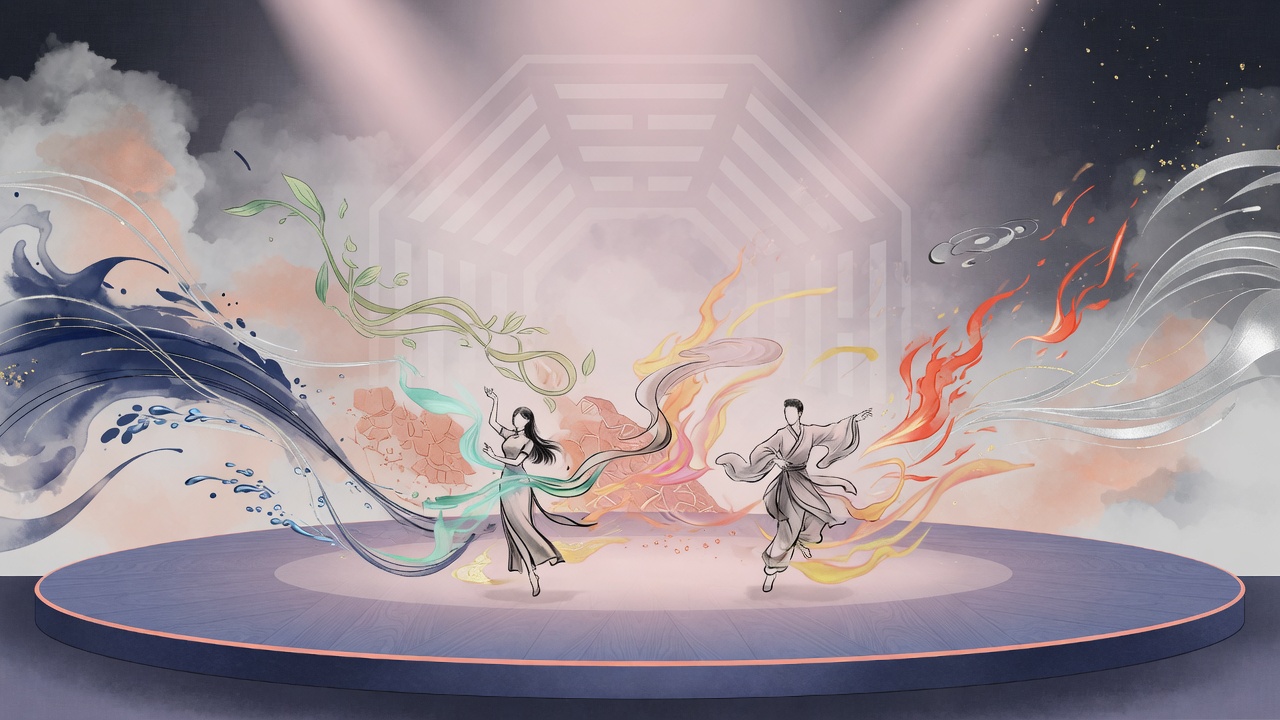
Beyond the configuration of Output and Peer Stars, the Day Master's Five Element nature adds a distinct hue to a performer's stage presence. By combining elemental traits, we can more vividly understand those vastly different performance styles.
- Wood-type performers (e.g., Jia Wood, Yi Wood Day Masters): Growth and extension are their instincts. Their performances are often filled with upward vitality, like high-wire acrobatics or vine-like fluid dance. Psychologically, Wood types are fairly stress-resistant but may temporarily wilt under 'pruning' (criticism) and need timely encouragement.
- Fire-type performers (Bing Fire, Ding Fire Day Masters): Passion, explosiveness, and infectious energy are Fire's hallmarks. Fire types are often the center of attention, skilled at igniting the entire venue in an instant, like intense percussion or flame-filled magic. But Fire can easily become restless; they may experience extreme anxiety while waiting for results and must learn to control their emotional 'flame.'
- Earth-type performers (Wu Earth, Ji Earth Day Masters): Stable, grounded, and rhythm-focused. Earth performers often bring solid, dependable skills, such as strength balancing or large prop manipulation. They are the most psychologically stable but may lack a 'wow' factor, needing Output Stars to 'loosen the soil' and show a more agile side.
- Metal-type performers (Geng Metal, Xin Metal Day Masters): Sharp, precise, and pursuing the extreme. Metal types excel at talents requiring meticulous technique, like quick-change acts or knife throwing. They are fiercely competitive and brood over wins and losses; the Peer Star's competitive drive is most evident in Metal types.
- Water-type performers (Ren Water, Gui Water Day Masters): Flowing, changeable, and unfathomable. Water performers often bring a sense of flow, like underwater ballet or liquid light shows. They have excellent psychological flexibility and can adjust strategies to the environment, but sometimes they are too low-key and need a push from Peer Stars to dare to step into the spotlight.
The Interplay of Output and Peer Stars: A Microcosm of Life on Stage
- Strong Output, weak Peer Stars: Brilliantly talented but poor at competing; prone to underperforming under high pressure. Such performers need a team or coach to act as their 'Peer Stars' and shield them from external stress.
- Strong Peer Stars, weak Output: Fiercely determined but stiff in expression; technically solid yet lacking infectious charm. They need deliberate training in 'showmanship' to soften their competitive edge with Output energy.
- Balanced Output and Peer Stars: Able to consistently output talent while growing stronger through competition — the most formidable opponent on stage. Many AGT champions have this balance in their charts.
- Influence of luck cycles: Even if the natal chart lacks prominent Output Stars, if a performer enters an Output Star luck cycle or year during the competition, they may suddenly 'unlock' unprecedented creativity. Conversely, a Peer Star year intensifies rivalry and often produces dark horses.
Practical Advice: Viewing Destiny and Competition Rationally
Points to Note
- Do not use Bazi to predict competition results. Bazi analyzes personality tendencies and potential energy, not fate. Stage performance is influenced by countless variables — on-the-spot condition, equipment, judge preferences — destiny analysis cannot overstep its bounds.
- Avoid 'labeling' contestants. Saying a performer is 'aggressive because of strong Peer Stars' is one-sided. Everyone is a complex blend; the same Ten Gods in different chart positions and combinations carry entirely different meanings.
- Output Stars do not guarantee success. Output Stars vent energy; if they are too strong without control, they can turn into 'Hurting Officer Clashing with Officer,' bringing disputes, verbal conflicts, or mistakes born of arrogance. Talent needs the sedimentation of the Resource Star and the monetizing ability of the Wealth Star.
- Peer Star competition can be healthy or toxic. Healthy competition stimulates potential; toxic competition drains the spirit. The destiny advice is: people with strong Peer Stars should choose collaborative tracks, viewing opponents as partners for mutual growth rather than enemies.
- Five Element styles are a reference, not a limitation. A Water type can erupt with fiery passion, and a Metal type can display watery suppleness. Postnatal training can transcend innate elemental frameworks. Bazi is a map, not a cage.
Summary and Recap
The AGT 21 stage acts like a magnifying glass, vividly showcasing the talent flow of Output Stars venting flourishing energy and the competitive instinct of Peer Stars vying for strength. Output Stars define the tone and appeal of a performance, while Peer Stars govern how contestants face pressure and rivals. By incorporating the Day Master's Five Elements, we glimpse how Wood's stretching, Fire's erupting, Earth's steadiness, Metal's sharpness, and Water's fluidity intertwine under the spotlight.
Understanding this traditional wisdom is not about ranking winners and losers, but about appreciating the psychological dynamics behind every kind of talent. Talent needs an outlet, competition needs balance, and the stage ultimately belongs to those who can both ignite their own fire and dance with their rivals.